Originally published by London Theatre Reviews, November 10th 2019:
http://www.londontheatrereviews.co.uk/post.cfm?p=1970
The cast of 1984. Credit: Rishi Rai
Seemingly ever-more relevant in our age of ubiquitous tech and social media surveillance, the Questors Theatre celebrates its 90th anniversary with a new production of Matthew Dunster’s stage adaptation of Orwell’s classic tale of Big Brother dystopia.
In a future with a boot stamping on a human face forever, rebel Winston Smith fights back against the system even as he works in a government office responsible for erasing and rewriting the history of the Revolution and The War, with devastating consequences for him and the non-conforming woman he loves.
Director Roger Beaumont’s production is a technically spectacular achievement, with the lavish, beautifully detailed set making ingenious use of multiple video screens, sound systems and film to immerse the audience in an unusually participative, cinematic theatre experience. Lighting and sound renders the unfolding scenes in visually striking, artful ways, and the entire show’s Production Team deserves high praise for pulling off such outstanding, complex technical work which is by far the biggest highlight of the show.
Julian Smith and Clare Purdy as Winston and Julia. Credit: Rishi Rai
Regrettably for this production, however, it seems that perhaps too much effort went into executing the technical side without a hitch, and that the actors’ need for rehearsals went neglected. With few exceptions, the majority of the cast seem to still be in the early phases of book work, doing little more than reciting their lines, albeit with great enthusiasm, but which nevertheless betrays a lack of thorough character work, leaving them feeling as though they are actors playing characters, not yet believably the characters themselves. The effect leaves Winston and Julia in particular feeling robotic, flying in the face of perhaps the entire point of the work, that the pair stand out as recognisably emotive and human against the brain-addled masses they rebel against. Later scenes that should inspire disturbed horror and revulsion are left far less impactful for it.
That less technically lavish productions have previously portrayed more believable versions all of the characters is a shame, and perhaps a warning against hyperfocus on one component over the other in future productions. Suspension of disbelief is often far more contingent on an actors’ ability to sell that belief than any lavish set’s efforts to convince an audience.
Still, there are some memorable performances to be found. David Erdos clearly enjoys chewing the scenery as an unconventionally loud O’Brien, John Turner’s Man in Pub is someone you’d like to share a half with, and the inventive staging of Simon Taylor’s Goldstein in his signature scene will, in the Questors’ particular space, surely give former students flashbacks to their stultifying lectures.
David Erdos' O'Brien with Julian Smith's Winston. Credit: Rishi Rai
Sunday, November 10, 2019
Wednesday, November 6, 2019
"Death of a Salesman" by Arthur Miller
Performed at The Piccadilly Theatre, London's West End, November 4th 2019
Also published in London Theatre Reviews, November 6th 2019: http://www.londontheatrereviews.co.uk/post.cfm?p=1954
Newly transferred from its lauded Spring season run at the Young Vic, directors Marianne Elliot and Miranda Cromwell bring their seminal production of Arthur Miller’s classic Death of a Salesman to the Piccadilly Theatre for Autumn.
Any production of Miller’s tragic, dramatic tale of the downtrodden Willie Loman and his desperate, seemingly hopeless struggles to make a living for his poor family passionately condemns the condescending nonsense of The American Dream, and the cruelty and abuse wrought by the excesses of capitalism on ordinary people – but this extraordinary reinvention confirms the long-held suspicions of many that Willie’s is a uniquely black socio-economic struggle by casting the Lomans as a black family from the South, eking out subsistence in the hurly-burly of 1930s’ New York, in the aftermath of both the Great Depression and the 1920s’ black cultural revolution throughout the American North.
Wendell Pierce and Sharon D. Clarke as the endearing Willie and Lorna Loman. Credit: Brinkhoff/Mögenburg
Elliot and Cromwell’s production is immediately enhanced with thematic urgency and with the depth of black history, one shared with a rich literary tradition of novels and plays, and which now seems so acutely necessary to any true grasp of this play that any other, white, staging of Willie Loman’s struggles comes off as almost wilfully ignorant and sorely lacking by comparison. Every aspect of Arthur Miller’s text is powerfully reinvented and reinvigorated, remade into a stirring clarion call against not only economic injustice, but all forms of racial discrimination under capitalism, and is rendered spectacularly better for it.
Leading a stellar cast with an outstanding performance is Wendell Pierce as Willie Loman. His new incarnation of Miller’s tragic hero masterfully embodies a unique shared history of distinctly black economic and social relations, brilliantly capturing a wonderfully complex interplay of forces bearing down upon him from within and without, his dogged adherence to the romantic notion of the American Dream always battling against a simultaneous harsh reality which he is endlessly driven to deny. Immediately commanding a powerful stage presence, Pierce’s Loman is by turns hugely energetic, funny, deeply complex and conflicted, and full of a palpable grief, frustration and anger ever-simmering beneath his seemingly happy exterior.
Sharon D. Clarke as wife Linda Loman beautifully performs a much-needed voice of calm and reason to Willie’s exhausting, hyperactive ambition, skilfully concealing her own pain and sorrow to play the dutiful, supportive wife – a sorrow which, when it fully emerges in the play’s most affecting scenes, is superbly realised. Together, their warm and loving relationship in their time together on stage, in bad times and good, is a heart-warming joy to behold, and full of great chemistry between the two.
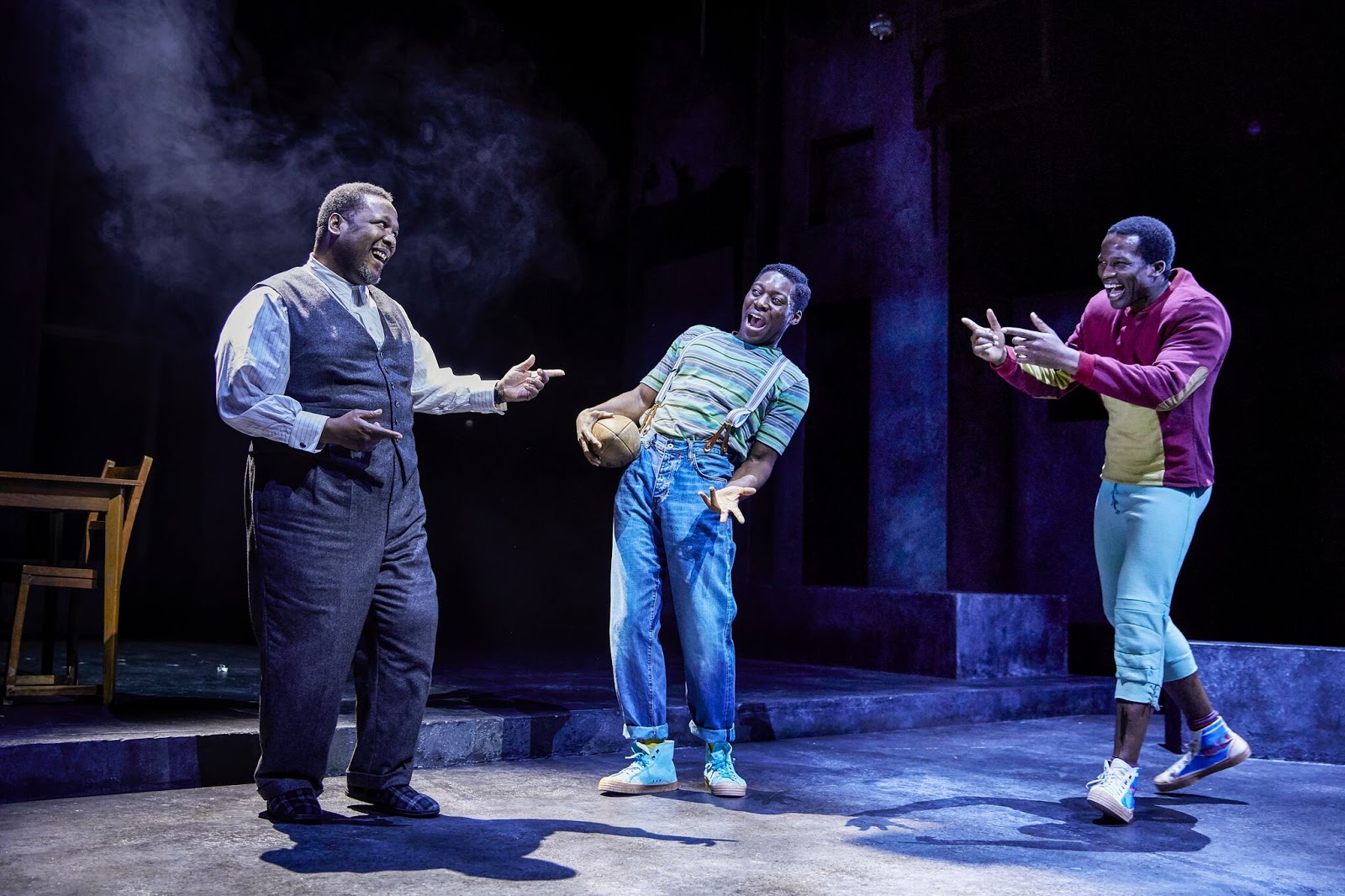
Pierce's Willie Loman with his sons, Sopé Dìrísù’s Biff and Natey Jones' Happy Loman. Credit: Brinkhoff/Mögenburg
The boys of the Loman family are strong in their turns as well, with Sopé Dìrísù’s Biff commanding a great presence and energy of his own alongside Natey Jones’ compelling Happy. In them both, resonant – indeed, renascent - themes of black struggle, and the attendant political contest of the means of liberation, persist. If their father is a Booker T. Washington type, intent on servile negotiation with the system, Happy is W E B Du Bois, determined to brook no restrictions on black freedom or enterprise, with the ambitious, soulful Biff instead a latter-day Marcus Garvey, insistent upon a need to get away from the capitalistic cruelties of city life to seek independent success away from New York’s hotbed of white prejudice, and from a system that demands he succeed only on its own terms. Jones and Dìrísù both perform with a keen awareness of this intertextual historical significance, and infuse their respective characters’ noble ambitions with a resultant richness, urgency, and complexity which it is a pleasure to watch, both actors transitioning skilfully from embodying their father’s fond hopes and dreams for them, to the pains and frustrations of their imperfect real lives.
Through Charlotte Sutton’s superb casting sensibilities, the Loman men’s struggles for success are ingeniously further situated as a struggle – both to beget and to be liberated from – proximity to whiteness. Whether by Willie leveraging the dorky white Bernard’s (a meek, earnest Ian Bonar) greater access to education for his underachieving son Biff, a literalised, torrid affair with whiteness embodied in Victoria Hamilton-Barritt’s seductive Woman, Joseph Mydell’s memorably enigmatic, gregarious Uncle Ben - dressed head-to-toe in conspicuously white finery whilst promising Willie diamonds for ever more toil - or the insensitive evil wrought by Matthew Seadon-Young’s cruel white boss Howard, the supporting cast is full of standout performances, enriching the drama and providing the play’s final revelation – that this essential release from capitalism’s myriad racialized cruelties comes, tragically, to mean very different things for Willie and his family - almost unbearably powerful, shocking dramatic effect.
Particular praise must go to set designer Anna Fleischle, whose singular, beautifully complex work has created something which seems as fluid and alive as any other character on her stage. It glides gracefully from scene to scene without interruption, with Aideen Malone’s dynamic lighting moving and changing just as seamlessly, much of it poignantly evocative of grim cold, and of a desolation both spiritual and material which is implicitly shot through the play’s text, made explicit by this wonderful design. Fleischle’s efforts seek to embody Willie’s erratic, panicked thoughts as he struggles with his patriarchal duty to his family, and his experience in a world which renders him small and insignificant against its own uncaring vastness. Fleischle’s spectacular achievement does just this, whilst also seeming to capture as well the transient, unstable nature of black life itself under such deplorable economic and social conditions. Hers is a truly masterful achievement, deserving of the highest commendation.
Left: Ian Bonar's Bernard with the Loman family. Credit: Brinkhoff/Mögenburg
Further manifesting the compellingly rich world of the play is the superb soundtrack, which pays loving tributes to both the bluesy jazz of the 20s’ Harlem renaissance and to the beautiful, soulful singing of the black gospel tradition, with tense and foreboding original composition underscoring Willie’s tragic tale in-between. Some fine costume work helps last of all, though not least, to put the final touches to a singularly brilliant production, which is never without tight direction from Elliot and Cromwell and consistently high energy from the spectacular cast. Although some transitions, particularly between penultimate scenes, seem somewhat out of step with the fluid grace of others, and energy may perhaps falter in places for having so often been taken to such extremes elsewhere, these are no detriment overall.
This incarnation of Miller’s most famous work is a superlative tour-de-force in every respect, a definitive theatre experience which is more than worthy of the standing ovation it received, and that deserves to be seen again and again.
Anna Fleischle has designed a beautiful set. Credit: Brinkhoff/Mögenburg
Also published in London Theatre Reviews, November 6th 2019: http://www.londontheatrereviews.co.uk/post.cfm?p=1954
Newly transferred from its lauded Spring season run at the Young Vic, directors Marianne Elliot and Miranda Cromwell bring their seminal production of Arthur Miller’s classic Death of a Salesman to the Piccadilly Theatre for Autumn.
Any production of Miller’s tragic, dramatic tale of the downtrodden Willie Loman and his desperate, seemingly hopeless struggles to make a living for his poor family passionately condemns the condescending nonsense of The American Dream, and the cruelty and abuse wrought by the excesses of capitalism on ordinary people – but this extraordinary reinvention confirms the long-held suspicions of many that Willie’s is a uniquely black socio-economic struggle by casting the Lomans as a black family from the South, eking out subsistence in the hurly-burly of 1930s’ New York, in the aftermath of both the Great Depression and the 1920s’ black cultural revolution throughout the American North.
Wendell Pierce and Sharon D. Clarke as the endearing Willie and Lorna Loman. Credit: Brinkhoff/Mögenburg
Elliot and Cromwell’s production is immediately enhanced with thematic urgency and with the depth of black history, one shared with a rich literary tradition of novels and plays, and which now seems so acutely necessary to any true grasp of this play that any other, white, staging of Willie Loman’s struggles comes off as almost wilfully ignorant and sorely lacking by comparison. Every aspect of Arthur Miller’s text is powerfully reinvented and reinvigorated, remade into a stirring clarion call against not only economic injustice, but all forms of racial discrimination under capitalism, and is rendered spectacularly better for it.
Leading a stellar cast with an outstanding performance is Wendell Pierce as Willie Loman. His new incarnation of Miller’s tragic hero masterfully embodies a unique shared history of distinctly black economic and social relations, brilliantly capturing a wonderfully complex interplay of forces bearing down upon him from within and without, his dogged adherence to the romantic notion of the American Dream always battling against a simultaneous harsh reality which he is endlessly driven to deny. Immediately commanding a powerful stage presence, Pierce’s Loman is by turns hugely energetic, funny, deeply complex and conflicted, and full of a palpable grief, frustration and anger ever-simmering beneath his seemingly happy exterior.
Sharon D. Clarke as wife Linda Loman beautifully performs a much-needed voice of calm and reason to Willie’s exhausting, hyperactive ambition, skilfully concealing her own pain and sorrow to play the dutiful, supportive wife – a sorrow which, when it fully emerges in the play’s most affecting scenes, is superbly realised. Together, their warm and loving relationship in their time together on stage, in bad times and good, is a heart-warming joy to behold, and full of great chemistry between the two.
Pierce's Willie Loman with his sons, Sopé Dìrísù’s Biff and Natey Jones' Happy Loman. Credit: Brinkhoff/Mögenburg
The boys of the Loman family are strong in their turns as well, with Sopé Dìrísù’s Biff commanding a great presence and energy of his own alongside Natey Jones’ compelling Happy. In them both, resonant – indeed, renascent - themes of black struggle, and the attendant political contest of the means of liberation, persist. If their father is a Booker T. Washington type, intent on servile negotiation with the system, Happy is W E B Du Bois, determined to brook no restrictions on black freedom or enterprise, with the ambitious, soulful Biff instead a latter-day Marcus Garvey, insistent upon a need to get away from the capitalistic cruelties of city life to seek independent success away from New York’s hotbed of white prejudice, and from a system that demands he succeed only on its own terms. Jones and Dìrísù both perform with a keen awareness of this intertextual historical significance, and infuse their respective characters’ noble ambitions with a resultant richness, urgency, and complexity which it is a pleasure to watch, both actors transitioning skilfully from embodying their father’s fond hopes and dreams for them, to the pains and frustrations of their imperfect real lives.
Through Charlotte Sutton’s superb casting sensibilities, the Loman men’s struggles for success are ingeniously further situated as a struggle – both to beget and to be liberated from – proximity to whiteness. Whether by Willie leveraging the dorky white Bernard’s (a meek, earnest Ian Bonar) greater access to education for his underachieving son Biff, a literalised, torrid affair with whiteness embodied in Victoria Hamilton-Barritt’s seductive Woman, Joseph Mydell’s memorably enigmatic, gregarious Uncle Ben - dressed head-to-toe in conspicuously white finery whilst promising Willie diamonds for ever more toil - or the insensitive evil wrought by Matthew Seadon-Young’s cruel white boss Howard, the supporting cast is full of standout performances, enriching the drama and providing the play’s final revelation – that this essential release from capitalism’s myriad racialized cruelties comes, tragically, to mean very different things for Willie and his family - almost unbearably powerful, shocking dramatic effect.
Particular praise must go to set designer Anna Fleischle, whose singular, beautifully complex work has created something which seems as fluid and alive as any other character on her stage. It glides gracefully from scene to scene without interruption, with Aideen Malone’s dynamic lighting moving and changing just as seamlessly, much of it poignantly evocative of grim cold, and of a desolation both spiritual and material which is implicitly shot through the play’s text, made explicit by this wonderful design. Fleischle’s efforts seek to embody Willie’s erratic, panicked thoughts as he struggles with his patriarchal duty to his family, and his experience in a world which renders him small and insignificant against its own uncaring vastness. Fleischle’s spectacular achievement does just this, whilst also seeming to capture as well the transient, unstable nature of black life itself under such deplorable economic and social conditions. Hers is a truly masterful achievement, deserving of the highest commendation.
Left: Ian Bonar's Bernard with the Loman family. Credit: Brinkhoff/Mögenburg
Further manifesting the compellingly rich world of the play is the superb soundtrack, which pays loving tributes to both the bluesy jazz of the 20s’ Harlem renaissance and to the beautiful, soulful singing of the black gospel tradition, with tense and foreboding original composition underscoring Willie’s tragic tale in-between. Some fine costume work helps last of all, though not least, to put the final touches to a singularly brilliant production, which is never without tight direction from Elliot and Cromwell and consistently high energy from the spectacular cast. Although some transitions, particularly between penultimate scenes, seem somewhat out of step with the fluid grace of others, and energy may perhaps falter in places for having so often been taken to such extremes elsewhere, these are no detriment overall.
This incarnation of Miller’s most famous work is a superlative tour-de-force in every respect, a definitive theatre experience which is more than worthy of the standing ovation it received, and that deserves to be seen again and again.
Anna Fleischle has designed a beautiful set. Credit: Brinkhoff/Mögenburg
Thursday, October 10, 2019
"Follow My Fingers" by Hannah West
Performed at The Bread and Roses Theatre, Clapham, October 9th 2019
Also published in London Theatre Reviews, October 10th 2019: http://www.londontheatrereviews.co.uk/post.cfm?p=1797
The first stage offering from new theatre and film company Rebel Act Productions, Follow My Fingers presents a strikingly dark, introspective tale of deep trauma and painstaking recovery for one young woman and her group of travelling friends.
Writer, director, producer, set designer, and lead actor Hannah West turns in a fine performance as Heather, skilfully alternating between pre and post-traumatic incarnations, one happy, bubbly, upbeat, and confident, and the other robbed of all enthusiasm for living as the work progresses, with Hannah West’s own minimalist set design fluidly intercutting from Heather’s variety of recollections to her time in therapy.
Many strong performances also litter the ensemble cast West has assembled for the work, nearly all female save one, and remarkable for the refreshing variety and depth of women’s personalities on display. Abigail Davies is a memorably mousy Sally, a pious woman of God, Hanna Durham’s Claire is a wellspring of humour with fine comic timing, Sophie Hill’s Annie provides a loud and boisterous counterweight to Sally, and Jessikah Wilson has an excellent manner with her client as Heather’s therapist, alongside smaller roles.
The work boasts a practically all-female cast of diverse characters
Meanwhile, Jamie Basardi’s solitary male presence displays great range as he convincingly performs a variety of different characters in vital bit-parts. Ably assisted by movement director Marlie Haco, the women in particular are all wonderful actresses, possessing great skill in transporting the audience from the confines of West’s sparse set surroundings into a variety of convincing scenarios and locations without the aid of extravagant sets or props, instead using movement and performance to create a variety of visually striking tableaus.
West’s writing is first-rate, too, with her script mounting in palpable tension and dread before finally exploding into an emotionally harrowing crescendo of traumatic shock and grief which makes a real, visceral impact.
Her script is full of energy, warmth, humanity, and humour, and explores everything from the prior build-up to the traumatic event itself, the aftermath, and the long, slow road to recovery. In all this, she shows great emotional sensitivity and a pleasing depth to her research of a charged and delicate central subject – her title, Follow My Fingers, is itself derived from the trauma therapy technique of replicating the rapid eye movement of dreaming to process shock in Eye Movement Desensitization Therapy.
Indeed, some of the more dramatic moments seemed so authentic and powerful that audience members were moved to tears. Though, perhaps, West’s talent for writing striking moments is a touch too great, as the play could’ve ended at several prior points in the last few minutes with no loss of quality; and, initially, as the play warms up to its impactful moments, the lighter writing seems to be very conventional youth travel story fare – but the larger dramatic moments at which West excels, and her talented cast, help to elevate the work beyond the usual standard, and its sincere, nuanced exploration of trauma by way of a conventional travel story is a refreshing twist which gives these proceedings an impressive narrative depth and broader socio-political importance in our age of sincerity and openness about mental health.
Jamie Basardi with Hannah West and Sophie Hill
Of great help to the depth of immersion in the tale is Zoe Smith’s sound and lighting together with Hannah West’s set design. The performance space makes an immediate impact, with its sparse and minimal white furniture visually striking against a sheer black background, which together with the cast unabashedly using the seating gangway as staging unto itself in a very enclosed space evokes the themes of intimacy and exposure very well. So, too, is there music on offer from the brother-sister duo of Sam and Hannah West, which joins the other elements of sound design in both adding to the initial lightness of tone and furthering a sense of later trauma, as Smith’s sound design gradually melds it into a disjointed cacophony of noise as Heather’s mind itself becomes a more confused and shaken environment.
A very well put-together, dramatic, and emotionally impactful work full of strong writing, wonderful design and great performances. As a very first theatre outing for a newly-formed company, Follow My Fingers is certainly an excellent, impressive initial effort. One looks forward to seeing where Rebel Act Productions, and the multi-talented Hannah West, go from here.
Also published in London Theatre Reviews, October 10th 2019: http://www.londontheatrereviews.co.uk/post.cfm?p=1797
The first stage offering from new theatre and film company Rebel Act Productions, Follow My Fingers presents a strikingly dark, introspective tale of deep trauma and painstaking recovery for one young woman and her group of travelling friends.
Writer, director, producer, set designer, and lead actor Hannah West turns in a fine performance as Heather, skilfully alternating between pre and post-traumatic incarnations, one happy, bubbly, upbeat, and confident, and the other robbed of all enthusiasm for living as the work progresses, with Hannah West’s own minimalist set design fluidly intercutting from Heather’s variety of recollections to her time in therapy.
Many strong performances also litter the ensemble cast West has assembled for the work, nearly all female save one, and remarkable for the refreshing variety and depth of women’s personalities on display. Abigail Davies is a memorably mousy Sally, a pious woman of God, Hanna Durham’s Claire is a wellspring of humour with fine comic timing, Sophie Hill’s Annie provides a loud and boisterous counterweight to Sally, and Jessikah Wilson has an excellent manner with her client as Heather’s therapist, alongside smaller roles.
The work boasts a practically all-female cast of diverse characters
Meanwhile, Jamie Basardi’s solitary male presence displays great range as he convincingly performs a variety of different characters in vital bit-parts. Ably assisted by movement director Marlie Haco, the women in particular are all wonderful actresses, possessing great skill in transporting the audience from the confines of West’s sparse set surroundings into a variety of convincing scenarios and locations without the aid of extravagant sets or props, instead using movement and performance to create a variety of visually striking tableaus.
West’s writing is first-rate, too, with her script mounting in palpable tension and dread before finally exploding into an emotionally harrowing crescendo of traumatic shock and grief which makes a real, visceral impact.
Her script is full of energy, warmth, humanity, and humour, and explores everything from the prior build-up to the traumatic event itself, the aftermath, and the long, slow road to recovery. In all this, she shows great emotional sensitivity and a pleasing depth to her research of a charged and delicate central subject – her title, Follow My Fingers, is itself derived from the trauma therapy technique of replicating the rapid eye movement of dreaming to process shock in Eye Movement Desensitization Therapy.
Indeed, some of the more dramatic moments seemed so authentic and powerful that audience members were moved to tears. Though, perhaps, West’s talent for writing striking moments is a touch too great, as the play could’ve ended at several prior points in the last few minutes with no loss of quality; and, initially, as the play warms up to its impactful moments, the lighter writing seems to be very conventional youth travel story fare – but the larger dramatic moments at which West excels, and her talented cast, help to elevate the work beyond the usual standard, and its sincere, nuanced exploration of trauma by way of a conventional travel story is a refreshing twist which gives these proceedings an impressive narrative depth and broader socio-political importance in our age of sincerity and openness about mental health.
Jamie Basardi with Hannah West and Sophie Hill
Of great help to the depth of immersion in the tale is Zoe Smith’s sound and lighting together with Hannah West’s set design. The performance space makes an immediate impact, with its sparse and minimal white furniture visually striking against a sheer black background, which together with the cast unabashedly using the seating gangway as staging unto itself in a very enclosed space evokes the themes of intimacy and exposure very well. So, too, is there music on offer from the brother-sister duo of Sam and Hannah West, which joins the other elements of sound design in both adding to the initial lightness of tone and furthering a sense of later trauma, as Smith’s sound design gradually melds it into a disjointed cacophony of noise as Heather’s mind itself becomes a more confused and shaken environment.
A very well put-together, dramatic, and emotionally impactful work full of strong writing, wonderful design and great performances. As a very first theatre outing for a newly-formed company, Follow My Fingers is certainly an excellent, impressive initial effort. One looks forward to seeing where Rebel Act Productions, and the multi-talented Hannah West, go from here.
Sunday, August 4, 2019
"Clara" by Elena Mazzon
Performed at Ram Jam Records at The Grey Horse, August 2nd 2019
Also published in London Theatre Reviews, August 4th 2019: http://www.londontheatrereviews.co.uk/post.cfm?p=1582
The history of classical music – as with many other fields of human endeavour – sadly too often omits the presence of great women from its cultural and historical memory. Fortunately, writer and performer Elena Mazzon together with director Catriona Kerridge issues a bold challenge to this unjust patriarchal dominion with Clara – Sex, Love and Classical Music, a one-women show devoted to vividly bringing Clara Schumann, née Wieck, the brilliant classical composer, pianist, and later wife to the better-known Robert Schumann, back to life in full colour to tell her story to the world.
Mazzon is superb as Clara, single-handedly carrying the entire show and creating a relentlessly energetic presence so vividly realised that one almost feels as though the former Wieck herself has emerged into the present day. Her performance – ably assisted by Peter Wernock’s voice and movement coaching - is a richly coloured tapestry of shared humanity in everything from her fiery, righteously feminist speech to the subtleties of her bold and confident body language. Mazzon’s beautifully written, evocative monologue charts a course through every aspect of Clara’s storied life from her remarkable childhood through to struggling to be an artistically ambitious, unreservedly sexual woman in 1830s Europe, to the tragic end of her marriage to Robert and beyond.
The skilful performance and writing together, broken up by apropos samples of Clara’s work performed live on the piano by Mazzon to lend proceedings a musica a programma significance thanks to musical director Stefania Passamonte, broadens and deepens our perception of Clara’s lived history, and gradually reveals more and more of a story of human triumph which is by turns dramatic, funny, heart-warming, and tragic in all the ways a life is. As a one-hander performance, Mazzon’s work is a joy to behold; as a first-time debut writer, she proves herself hugely talented and accomplished.
The candlelit interior of Ram Jam Records’ piano bar also proves a beautiful, intimate surrounding, keeping us in close proximity to Clara’s presence throughout, and maintaining the all-too appropriate sense amongst the audience of attending a concert or recital, which, in this instance, with the candlelight seemingly our only light source, creates a thrillingly mystic feeling of séance and resurrection to bolster the sense of the spirit of Clara being brought back to life.
Superbly realised, evocatively written, and beautifully performed drama altogether. A triumph.
Also published in London Theatre Reviews, August 4th 2019: http://www.londontheatrereviews.co.uk/post.cfm?p=1582
The history of classical music – as with many other fields of human endeavour – sadly too often omits the presence of great women from its cultural and historical memory. Fortunately, writer and performer Elena Mazzon together with director Catriona Kerridge issues a bold challenge to this unjust patriarchal dominion with Clara – Sex, Love and Classical Music, a one-women show devoted to vividly bringing Clara Schumann, née Wieck, the brilliant classical composer, pianist, and later wife to the better-known Robert Schumann, back to life in full colour to tell her story to the world.
Mazzon is superb as Clara, single-handedly carrying the entire show and creating a relentlessly energetic presence so vividly realised that one almost feels as though the former Wieck herself has emerged into the present day. Her performance – ably assisted by Peter Wernock’s voice and movement coaching - is a richly coloured tapestry of shared humanity in everything from her fiery, righteously feminist speech to the subtleties of her bold and confident body language. Mazzon’s beautifully written, evocative monologue charts a course through every aspect of Clara’s storied life from her remarkable childhood through to struggling to be an artistically ambitious, unreservedly sexual woman in 1830s Europe, to the tragic end of her marriage to Robert and beyond.
The skilful performance and writing together, broken up by apropos samples of Clara’s work performed live on the piano by Mazzon to lend proceedings a musica a programma significance thanks to musical director Stefania Passamonte, broadens and deepens our perception of Clara’s lived history, and gradually reveals more and more of a story of human triumph which is by turns dramatic, funny, heart-warming, and tragic in all the ways a life is. As a one-hander performance, Mazzon’s work is a joy to behold; as a first-time debut writer, she proves herself hugely talented and accomplished.
The candlelit interior of Ram Jam Records’ piano bar also proves a beautiful, intimate surrounding, keeping us in close proximity to Clara’s presence throughout, and maintaining the all-too appropriate sense amongst the audience of attending a concert or recital, which, in this instance, with the candlelight seemingly our only light source, creates a thrillingly mystic feeling of séance and resurrection to bolster the sense of the spirit of Clara being brought back to life.
Superbly realised, evocatively written, and beautifully performed drama altogether. A triumph.
Review: "Nostalgia" by Clive Moffatt
Performed at The White Bear Theatre, July 31st 2019
Also published by London Theatre Reviews, August 2nd 2019: http://www.londontheatrereviews.co.uk/post.cfm?p=1578
A new lyrical revue from Nomadic Theatrical Productions’ writer-director Clive Moffatt, “Nostalgia” is a narrative tour of various pasts told through the different recollections of a vibrant ensemble cast of characters, exploring the meaning, importance, and relevance of our memories of years gone by, especially in older age, and in the remembrances of young adults recalling their halcyon schooldays.
Clive Elliot, central to the cast as a flamboyant narrator, proves a highlight as a great storyteller, by turns funny, compelling, warm, and sincere with a strong, visually distinct stage presence. Liam Weller provides a nice contrast as a younger, knock-kneed schoolboy, bringing a charm and innocence to his rose-tinted recollections of school, and Jayne Beaumont as The Woman gives one of the most powerful and emotive performances, recalling a deeply troubled and traumatic past. Nick Rutherford and Ian Recordon meanwhile bring their own presence and emotive command of the text to the work nicely.
The writing itself, whilst having isolated moments of genuine, evocative affect and good craft, can sometimes feel disjointed, as though the series of monologues which bind the work together do not form a single coherent narrative so much as a series of writing exercises on a theme. Clive Moffatt’s light-touch direction together with Gwenan Bain and Chuma Emembolu’s lighting and sound, though, help to bring things together into a coherent whole, with Emembolu’s sound direction in particular making good use of some musical staples of classical and big band fare to evoke the titular nostalgia for a different era.
More an avant-garde exercise on a theme than anything particularly ground-breaking, certainly, but enjoyable performances and affecting writing help to bring everything together into a consistently interesting, reflective evening of theatre.
Clive Elliot with Ian Recordon as the Narrator and Older Man. Credit: Matthew Partridge
Also published by London Theatre Reviews, August 2nd 2019: http://www.londontheatrereviews.co.uk/post.cfm?p=1578
A new lyrical revue from Nomadic Theatrical Productions’ writer-director Clive Moffatt, “Nostalgia” is a narrative tour of various pasts told through the different recollections of a vibrant ensemble cast of characters, exploring the meaning, importance, and relevance of our memories of years gone by, especially in older age, and in the remembrances of young adults recalling their halcyon schooldays.
Clive Elliot, central to the cast as a flamboyant narrator, proves a highlight as a great storyteller, by turns funny, compelling, warm, and sincere with a strong, visually distinct stage presence. Liam Weller provides a nice contrast as a younger, knock-kneed schoolboy, bringing a charm and innocence to his rose-tinted recollections of school, and Jayne Beaumont as The Woman gives one of the most powerful and emotive performances, recalling a deeply troubled and traumatic past. Nick Rutherford and Ian Recordon meanwhile bring their own presence and emotive command of the text to the work nicely.
The writing itself, whilst having isolated moments of genuine, evocative affect and good craft, can sometimes feel disjointed, as though the series of monologues which bind the work together do not form a single coherent narrative so much as a series of writing exercises on a theme. Clive Moffatt’s light-touch direction together with Gwenan Bain and Chuma Emembolu’s lighting and sound, though, help to bring things together into a coherent whole, with Emembolu’s sound direction in particular making good use of some musical staples of classical and big band fare to evoke the titular nostalgia for a different era.
More an avant-garde exercise on a theme than anything particularly ground-breaking, certainly, but enjoyable performances and affecting writing help to bring everything together into a consistently interesting, reflective evening of theatre.
Clive Elliot with Ian Recordon as the Narrator and Older Man. Credit: Matthew Partridge
Wednesday, July 10, 2019
Review: Henrik Ibsen’s An Enemy of The People by Jolley Goswald
Originally published in London Theatre Reviews, July 10th 2019 (http://www.londontheatrereviews.co.uk/post.cfm?p=1479)
Performed at the Playground Theatre.
Fringe company Here Now Ensemble, and their director Jolley Goswald, have certainly not shied away from the renewed social and political relevance of Henrik Ibsen’s original play. The dramatic tale of a principled, educated whistle-blower’s life being ruined by a corrupt, self-serving establishment that would rather profit from wilful ignorance of an imminent danger to the local community does indeed seem grimly topical in our modern, post-Brexit ,‘sick of experts’ political landscape, and the company’s very deliberate decision to perform in a venue literally down the road from Grenfell Tower places the writing within a chilling, morbidly timely new context.
It may have been enough, under these dire meta-fictional circumstances, simply to stage the original work and leave the audience to infer the modern meanings for themselves; but theatregoers expecting to arrive to a straightforward adaptation of Ibsen should leave their expectations in the foyer and prepare for an almost entirely new version of the play, one rewritten from the ground up to embrace modernity, and unafraid to explicitly name the problems of Brexit, austerity, capitalism and anti-feminism. Together with the production’s distinctly Brechtian fourth-wall-breaking sensibilities – its cast of characters named for their real-life actors, and lead Hannah van der Westhuysen explicitly halting the action to address the audience as participants, and state aims of using theatre as a forum for political engagement and calls to positive action - little remains here for fans of Ibsen but the bare-bones of his faithfully recreated plot, construed in an almost improvised, vulgar stream-of-consciousness by a talented and capable cast of performers with a strong stage presence. Purists may balk to find everything so changed, but it is a bold, fascinating approach to the text nonetheless.
Credit: Jolley Goswald
Goswald’s direction is full of laudable confidence in his vision and together with his actors he manages to never lose a refreshingly naturalistic, fast-paced feel and an engaging atmosphere which is always a pleasure, although it is not an approach that always works textually. At times, dialogue can feel a little too improvised, as though cast members are stumbling for where to go next, and perhaps, like Ibsen’s Thomas Stockmann, the writing’s great flaw is that it can sometimes be too upfront in its desire to tell its truths. One scene in particular, although very well performed by an energetic and impassioned Gabriel Akuwudike, veers perilously close to ludicrous soap opera melodrama that it can be difficult to take seriously, depending on one’s sensibilities. That said, at other times, when it works, there are genuinely great, pacey moments of compelling and affecting human drama that are well worth admission. It makes for something of a mixed bag, but one in which everybody is likely to find things they enjoy.
Meanwhile, Alys Whitehead’s compactly detailed set design visually helps along the writing’s ingenious transfer to distinctly modern, socialist millennial flat-share environs, Holly Ellis’ lighting lends dramatic thrust to all the right moments, and collaborating sibling Will Goswold’s sound design provides the enjoyable, youthful soundtrack. Doubtless many might find it an acquired taste, but it remains a brave, praiseworthy effort to revitalise the original text, full of talent, provocative originality, and life.
Performed at the Playground Theatre.
Fringe company Here Now Ensemble, and their director Jolley Goswald, have certainly not shied away from the renewed social and political relevance of Henrik Ibsen’s original play. The dramatic tale of a principled, educated whistle-blower’s life being ruined by a corrupt, self-serving establishment that would rather profit from wilful ignorance of an imminent danger to the local community does indeed seem grimly topical in our modern, post-Brexit ,‘sick of experts’ political landscape, and the company’s very deliberate decision to perform in a venue literally down the road from Grenfell Tower places the writing within a chilling, morbidly timely new context.
It may have been enough, under these dire meta-fictional circumstances, simply to stage the original work and leave the audience to infer the modern meanings for themselves; but theatregoers expecting to arrive to a straightforward adaptation of Ibsen should leave their expectations in the foyer and prepare for an almost entirely new version of the play, one rewritten from the ground up to embrace modernity, and unafraid to explicitly name the problems of Brexit, austerity, capitalism and anti-feminism. Together with the production’s distinctly Brechtian fourth-wall-breaking sensibilities – its cast of characters named for their real-life actors, and lead Hannah van der Westhuysen explicitly halting the action to address the audience as participants, and state aims of using theatre as a forum for political engagement and calls to positive action - little remains here for fans of Ibsen but the bare-bones of his faithfully recreated plot, construed in an almost improvised, vulgar stream-of-consciousness by a talented and capable cast of performers with a strong stage presence. Purists may balk to find everything so changed, but it is a bold, fascinating approach to the text nonetheless.
Credit: Jolley Goswald
Goswald’s direction is full of laudable confidence in his vision and together with his actors he manages to never lose a refreshingly naturalistic, fast-paced feel and an engaging atmosphere which is always a pleasure, although it is not an approach that always works textually. At times, dialogue can feel a little too improvised, as though cast members are stumbling for where to go next, and perhaps, like Ibsen’s Thomas Stockmann, the writing’s great flaw is that it can sometimes be too upfront in its desire to tell its truths. One scene in particular, although very well performed by an energetic and impassioned Gabriel Akuwudike, veers perilously close to ludicrous soap opera melodrama that it can be difficult to take seriously, depending on one’s sensibilities. That said, at other times, when it works, there are genuinely great, pacey moments of compelling and affecting human drama that are well worth admission. It makes for something of a mixed bag, but one in which everybody is likely to find things they enjoy.
Meanwhile, Alys Whitehead’s compactly detailed set design visually helps along the writing’s ingenious transfer to distinctly modern, socialist millennial flat-share environs, Holly Ellis’ lighting lends dramatic thrust to all the right moments, and collaborating sibling Will Goswold’s sound design provides the enjoyable, youthful soundtrack. Doubtless many might find it an acquired taste, but it remains a brave, praiseworthy effort to revitalise the original text, full of talent, provocative originality, and life.
Friday, July 5, 2019
Review: Spitfire Sisters by Three of a Kind
(Originally published in London Theatre Reviews, July 5th 2019: http://www.londontheatrereviews.co.uk/post.cfm?p=1455)
Performed at The Space Theatre, July 3rd 2019
In 1973, the poet Harold Bloom famously wrote about what he called The Anxiety of Influence. The backbone of his theory of poetry, he thought that most new writers, inspired by reading about the greats that had come before, would feel too much pressure to measure up to them and to win their imagined approval. So they would buckle under the strain and end up producing derivative, ephemeral fare, of which the people they idolise would surely not approve.
Spitfire Sisters, the second offering from the writing team of Doc Andersen-Bloomfield, Catherine Comfort and Heather Dunmore, together known as Three of a Kind, is an ambitious work of new writing. Unfortunately, this fictionalised docudrama chronicling the history of the women serving in the Air Transport Auxiliary during World War II is let down by a host of peculiar, questionable creative decisions which keep the production – the earnest and laudable effort of giving women’s underappreciated history a sizeable platform and attempting to create something of which their forebears could be proud notwithstanding – from being all that it could be.
Things get off to a promising start with Sound Designer Kerri Chesser’s selection of classic Glenn Miller Big Band fare helpfully evoking the wartime spirit of the 40s, and the sparse set design suggesting the interior of the famous White Waltham Airbase, from which the women were deployed to deliver planes to the frontlines; but between lacklustre writing which the committed actors struggle to work with, Adam Hemming’s poltroonish direction and short-sighted staging, and Andy Straw’s confusing and irritating lighting design, things swiftly deteriorate into an unfocused, plodding bore which it is difficult to like, no matter how much one might want to.

Faye Maughan does her duty as Phyllis Griggs. Photography by Liz Isles
Above all, the distinctly one-dimensional writing, itself likely derivative of Giles Whittell’s non-fiction book Spitfire Women of World War II, pervades and tarnishes every other aspect of the production. The play’s cast of characters, all of which feel woefully underdeveloped and poorly written, especially in their oftentimes overformal and unrealistic dialogue, seem to be drawn from two historical figures each, leaving them feeling indistinct, and like poor substitutes for far more interesting individual historical figures. Faye Maughan’s Phyllis Griggs is clearly set in the mould of women like Rosemary Rees – whose husband urged her to purchase a personal Miles Hawk Major plane to improve her social life - and Pauline Gower – daughter of a high-up Tory MP, who fought for the right to wear trousers. Alessandra Perotto is the bold and brave Typhoon-flying, twice-Severn-Bridge-ducking Ann Wood and the spirited Jackie Cochran – who steadfastly refused to ever allow the British to “put her in her place” - at once, which unfortunately seems to cause her affected Appalachian American accent to constantly slip. Meanwhile, Mary Roubous endearingly combines the physically sickly intellect of Mary de Bunsen with the animal-loving introversion of the Argentine Picture Post pin-up Maureen Dunlop.
Unfortunately, this style of merging two distinct people and personalities together to create a single fictional analogue at best leaves the new characters feeling indistinct and underwritten, and at worst carries a meta-fictional suggestion that these women’s real lives and histories can be freely swapped around, tinkered with, and whittled down to useful storytelling props in the pursuit of crafting tiresomely didactic theatre. Their composite lives are unexamined and never fully realised, with the writing disinterested in saying anything more substantial about the significance of 40s-era women’s nobility, bravery, courage and sacrifice in wartime service to their country besides sternly finger-wagging at only the most glaringly obvious, almost cartoonish misogyny, and the self-evident economic injustice of a workplace earnings gap, lazily garnished with only the most superficial references to the real, unexamined history.
Indeed, for all the work’s promotional bluster about feminism, the writing is full of bizarre and ill-considered contradictions. In the course of the story – seemingly little more than a rudderless lecture on How Sexism Is Bad, which lacks any distinguishable narrative beginning, middle, or end - one so-called sister hands in her resignation early so she can run off to marry a rich man – naturally the most important priority in a woman’s life, never mind standing up to Hitler and the Nazis for her country. It is difficult to imagine that the late, great A.T.A pilot Joan Hughes, of the four-engine flight clearance elite, whom never married lest a man come between her and her love of flying, would approve of such antics.

The Spitfire Sisters face down an air raid in a dramatic moment. Photography by Liz Isles
Later on, a horrifically burned man (Steven Shawcroft’s RAF Airman Nigel in a totally unconvincing, obviously rubber face prosthesis) makes grossly inappropriate pleas to another woman not to risk flying because she’s too beautiful, lest a similar accident tarnish her pin-up model good looks (surely the only thing of value that she can contribute to the war effort) and then has his backwards attitude and thoroughly weird, stalky, out-of-nowhere infatuation – frightfully uncharacteristic of real A.T.A men that simply treated the women as respected colleagues - helpfully validated when she predictably dies in a crash. This despite many real female A.T.A pilots, like Amy Johnson, Audrey Sale-Barker and Joan Page, historically surviving numerous plane crashes and assorted in-flight emergencies, badly injured though they may have been. This way, he gets to feel justified in blaming the other women for her death, and claiming that it proves they don’t deserve to be paid properly for their work. Of course.
“Well, there we are, then.” one feels lead to think, “That’ll teach those uppity women not to do as they’re told by men who know better.” It’s all really rather troubling. This cast of characters seem at times to be a tragic far cry from their real-life inspirations; unlike Joan Hughes, who refused to marry and put paid to sceptical Air Force men, Jackie Sarsour who proclaimed flying “the most natural thing in the world…as though my entire life had led to this moment”, Mary de Bunsen taking to the skies explicitly to escape “the ghastly fate of the daughter-in-waiting”, Jackie Cochran’s life’s ambition to be known as “the greatest woman pilot in history”, Margaret Duhalde and Ann Wood both fearlessly giving male officers a piece of their mind, or Maureen Dunlop’s simple preference for animals over people, the fictionalised women’s excitement seems to peak most of all at the thought of getting to throw parties, wear pretty dresses, and talk about boys. It hardly seems fitting of the real legacy which supposedly inspired them to life.
Yet, instead of the rich storytelling potential of all of this history and legacy, we are left with the shallow, proscriptive writing pressing on the point of contemporary earnings gap concerns, with the stories of our war heroes seemingly being used as little more than an alluring backdrop to hang a portrait of misogyny which manifests in ways so unsophisticated and glaringly obvious that it feels risibly condescending, so much so that it does the far more subtle realities of misogyny itself a disservice in representation. Of course misogyny is real, and doubtless woven deeply into the fabric of our society and culture, sometimes into the very structure and form of language itself – far more deeply, surely, that a few tired, predictable, off-colour remarks of ‘but you’re only a woman!’ in so many drab variations. That much is – or certainly ought to be - obvious to anybody paying a modicum of attention. Indeed, in Russia, until World War II, one literally could not use terms like ‘infantry’ or ‘machine gunner’ or ‘tank driver’ without explicitly referring to a man. New words had to be invented from scratch just to create space for women in the army, because the very concept was unfathomable. Such is the deplorable breadth and depth of women’s oppression, whether in America, Britain, Russia, or anywhere else in the world we live in, be it in the 1940s, or the modern day.
That being said, the first rule of good writing is to avoid telling the audience things they already know.

Saluting noble efforts. Photography by Liz Isles
Matters are not helped by such a culturally, historically, and artistically informed work – uniquely by women, about women’s experience, and singularly for women - being left in the hands of a male director, which feels quite simply inappropriate in a great many respects. In practice, Hemming is forced into a grim Scylla and Charybdis scenario of either appearing to appropriate the work of women writers and to be bossing around a majority-female cast as he pleases, or else, all-too aware of these dreadful optics, being so overcautious and hands-off that he may as well have given up the task altogether. Either way, he is left doomed to such innate incompetence with the material that it really seems that the writing team has been recklessly inconsiderate in ever giving it to him in the first place. One can’t help but feel, with the production otherwise so intent on touting the importance of feminism and women’s representation, that a female director would surely have been more apt, and certainly far more competent at the task.
Hemming, though, seemingly opts for the latter directing style, and consequently, the play is left feeling too loose, disjointed, and lacking in firm directorial vision to make any positive impression. His cast struggle with a lack of direction or input on their characters, seeming only to read their lines as fast as possible, moments of drama fail to make any impact, and staging decisions are sometimes ridiculously impractical. More than once, actors are positioned so far to stage right that those sitting on the right-hand side in the back literally cannot see them. Meanwhile, Andy Straw’s irritatingly confusing lighting too often aims for ‘atmospheric low light’ and lands in ‘too dim to see anything from the back of the room’. Straw and Hemming are also far too fond of total blackouts, rankly abusing them for simple scene transitions to the point of the audience beginning to clap despite the play being far from over. It was of no help to the disjointed feel of the writing and the unconfident direction.
An earnest and experienced cast do their best despite it all, to be sure. Annabel Smith and Chloe Wade in particular do an admirable job of delivering characterful monologues which constitute some of the strongest writing in the otherwise weak text. Alas, to paraphrase Hitchcock: “To make a great play, you need three things – the script, the script, and the script.”

Chloe Wade and Mary Roubos as Jessie Harris and Georgia Smythe-West. Photography by Liz Isles
Spitfire Sisters is a disappointing, forgettable failure in nearly every aspect, crippled by the Anxiety of Influence – but Three of a Kind should not give up their worthy ambitions. Instead, they should and must try again. They must keep writing, keep improving, and keep on championing the cause of recording women’s erased history, and not only for themselves. At present, it is grimly true that women, especially those in the public eye – be they actors or writers – are not allowed to fail. Such is the ruthless, cruel, impossible perfection endlessly demanded of them. That this production has failed, given the weight of its own ambition and the daunting shadow of the legacy it exists in, is unsurprising and no-one should be too harshly blamed. Anyone would struggle in those circumstances.
More importantly, this failure is no bad thing. Women, like all people, must be allowed to fail and be given new chances to succeed, just the same as men. Only then we will have any sort of real equality.

Fly by night. Photography by Liz Isles.
Performed at The Space Theatre, July 3rd 2019
In 1973, the poet Harold Bloom famously wrote about what he called The Anxiety of Influence. The backbone of his theory of poetry, he thought that most new writers, inspired by reading about the greats that had come before, would feel too much pressure to measure up to them and to win their imagined approval. So they would buckle under the strain and end up producing derivative, ephemeral fare, of which the people they idolise would surely not approve.
Spitfire Sisters, the second offering from the writing team of Doc Andersen-Bloomfield, Catherine Comfort and Heather Dunmore, together known as Three of a Kind, is an ambitious work of new writing. Unfortunately, this fictionalised docudrama chronicling the history of the women serving in the Air Transport Auxiliary during World War II is let down by a host of peculiar, questionable creative decisions which keep the production – the earnest and laudable effort of giving women’s underappreciated history a sizeable platform and attempting to create something of which their forebears could be proud notwithstanding – from being all that it could be.
Things get off to a promising start with Sound Designer Kerri Chesser’s selection of classic Glenn Miller Big Band fare helpfully evoking the wartime spirit of the 40s, and the sparse set design suggesting the interior of the famous White Waltham Airbase, from which the women were deployed to deliver planes to the frontlines; but between lacklustre writing which the committed actors struggle to work with, Adam Hemming’s poltroonish direction and short-sighted staging, and Andy Straw’s confusing and irritating lighting design, things swiftly deteriorate into an unfocused, plodding bore which it is difficult to like, no matter how much one might want to.

Faye Maughan does her duty as Phyllis Griggs. Photography by Liz Isles
Above all, the distinctly one-dimensional writing, itself likely derivative of Giles Whittell’s non-fiction book Spitfire Women of World War II, pervades and tarnishes every other aspect of the production. The play’s cast of characters, all of which feel woefully underdeveloped and poorly written, especially in their oftentimes overformal and unrealistic dialogue, seem to be drawn from two historical figures each, leaving them feeling indistinct, and like poor substitutes for far more interesting individual historical figures. Faye Maughan’s Phyllis Griggs is clearly set in the mould of women like Rosemary Rees – whose husband urged her to purchase a personal Miles Hawk Major plane to improve her social life - and Pauline Gower – daughter of a high-up Tory MP, who fought for the right to wear trousers. Alessandra Perotto is the bold and brave Typhoon-flying, twice-Severn-Bridge-ducking Ann Wood and the spirited Jackie Cochran – who steadfastly refused to ever allow the British to “put her in her place” - at once, which unfortunately seems to cause her affected Appalachian American accent to constantly slip. Meanwhile, Mary Roubous endearingly combines the physically sickly intellect of Mary de Bunsen with the animal-loving introversion of the Argentine Picture Post pin-up Maureen Dunlop.
Unfortunately, this style of merging two distinct people and personalities together to create a single fictional analogue at best leaves the new characters feeling indistinct and underwritten, and at worst carries a meta-fictional suggestion that these women’s real lives and histories can be freely swapped around, tinkered with, and whittled down to useful storytelling props in the pursuit of crafting tiresomely didactic theatre. Their composite lives are unexamined and never fully realised, with the writing disinterested in saying anything more substantial about the significance of 40s-era women’s nobility, bravery, courage and sacrifice in wartime service to their country besides sternly finger-wagging at only the most glaringly obvious, almost cartoonish misogyny, and the self-evident economic injustice of a workplace earnings gap, lazily garnished with only the most superficial references to the real, unexamined history.
Indeed, for all the work’s promotional bluster about feminism, the writing is full of bizarre and ill-considered contradictions. In the course of the story – seemingly little more than a rudderless lecture on How Sexism Is Bad, which lacks any distinguishable narrative beginning, middle, or end - one so-called sister hands in her resignation early so she can run off to marry a rich man – naturally the most important priority in a woman’s life, never mind standing up to Hitler and the Nazis for her country. It is difficult to imagine that the late, great A.T.A pilot Joan Hughes, of the four-engine flight clearance elite, whom never married lest a man come between her and her love of flying, would approve of such antics.

The Spitfire Sisters face down an air raid in a dramatic moment. Photography by Liz Isles
Later on, a horrifically burned man (Steven Shawcroft’s RAF Airman Nigel in a totally unconvincing, obviously rubber face prosthesis) makes grossly inappropriate pleas to another woman not to risk flying because she’s too beautiful, lest a similar accident tarnish her pin-up model good looks (surely the only thing of value that she can contribute to the war effort) and then has his backwards attitude and thoroughly weird, stalky, out-of-nowhere infatuation – frightfully uncharacteristic of real A.T.A men that simply treated the women as respected colleagues - helpfully validated when she predictably dies in a crash. This despite many real female A.T.A pilots, like Amy Johnson, Audrey Sale-Barker and Joan Page, historically surviving numerous plane crashes and assorted in-flight emergencies, badly injured though they may have been. This way, he gets to feel justified in blaming the other women for her death, and claiming that it proves they don’t deserve to be paid properly for their work. Of course.
“Well, there we are, then.” one feels lead to think, “That’ll teach those uppity women not to do as they’re told by men who know better.” It’s all really rather troubling. This cast of characters seem at times to be a tragic far cry from their real-life inspirations; unlike Joan Hughes, who refused to marry and put paid to sceptical Air Force men, Jackie Sarsour who proclaimed flying “the most natural thing in the world…as though my entire life had led to this moment”, Mary de Bunsen taking to the skies explicitly to escape “the ghastly fate of the daughter-in-waiting”, Jackie Cochran’s life’s ambition to be known as “the greatest woman pilot in history”, Margaret Duhalde and Ann Wood both fearlessly giving male officers a piece of their mind, or Maureen Dunlop’s simple preference for animals over people, the fictionalised women’s excitement seems to peak most of all at the thought of getting to throw parties, wear pretty dresses, and talk about boys. It hardly seems fitting of the real legacy which supposedly inspired them to life.
Yet, instead of the rich storytelling potential of all of this history and legacy, we are left with the shallow, proscriptive writing pressing on the point of contemporary earnings gap concerns, with the stories of our war heroes seemingly being used as little more than an alluring backdrop to hang a portrait of misogyny which manifests in ways so unsophisticated and glaringly obvious that it feels risibly condescending, so much so that it does the far more subtle realities of misogyny itself a disservice in representation. Of course misogyny is real, and doubtless woven deeply into the fabric of our society and culture, sometimes into the very structure and form of language itself – far more deeply, surely, that a few tired, predictable, off-colour remarks of ‘but you’re only a woman!’ in so many drab variations. That much is – or certainly ought to be - obvious to anybody paying a modicum of attention. Indeed, in Russia, until World War II, one literally could not use terms like ‘infantry’ or ‘machine gunner’ or ‘tank driver’ without explicitly referring to a man. New words had to be invented from scratch just to create space for women in the army, because the very concept was unfathomable. Such is the deplorable breadth and depth of women’s oppression, whether in America, Britain, Russia, or anywhere else in the world we live in, be it in the 1940s, or the modern day.
That being said, the first rule of good writing is to avoid telling the audience things they already know.

Saluting noble efforts. Photography by Liz Isles
Matters are not helped by such a culturally, historically, and artistically informed work – uniquely by women, about women’s experience, and singularly for women - being left in the hands of a male director, which feels quite simply inappropriate in a great many respects. In practice, Hemming is forced into a grim Scylla and Charybdis scenario of either appearing to appropriate the work of women writers and to be bossing around a majority-female cast as he pleases, or else, all-too aware of these dreadful optics, being so overcautious and hands-off that he may as well have given up the task altogether. Either way, he is left doomed to such innate incompetence with the material that it really seems that the writing team has been recklessly inconsiderate in ever giving it to him in the first place. One can’t help but feel, with the production otherwise so intent on touting the importance of feminism and women’s representation, that a female director would surely have been more apt, and certainly far more competent at the task.
Hemming, though, seemingly opts for the latter directing style, and consequently, the play is left feeling too loose, disjointed, and lacking in firm directorial vision to make any positive impression. His cast struggle with a lack of direction or input on their characters, seeming only to read their lines as fast as possible, moments of drama fail to make any impact, and staging decisions are sometimes ridiculously impractical. More than once, actors are positioned so far to stage right that those sitting on the right-hand side in the back literally cannot see them. Meanwhile, Andy Straw’s irritatingly confusing lighting too often aims for ‘atmospheric low light’ and lands in ‘too dim to see anything from the back of the room’. Straw and Hemming are also far too fond of total blackouts, rankly abusing them for simple scene transitions to the point of the audience beginning to clap despite the play being far from over. It was of no help to the disjointed feel of the writing and the unconfident direction.
An earnest and experienced cast do their best despite it all, to be sure. Annabel Smith and Chloe Wade in particular do an admirable job of delivering characterful monologues which constitute some of the strongest writing in the otherwise weak text. Alas, to paraphrase Hitchcock: “To make a great play, you need three things – the script, the script, and the script.”

Chloe Wade and Mary Roubos as Jessie Harris and Georgia Smythe-West. Photography by Liz Isles
Spitfire Sisters is a disappointing, forgettable failure in nearly every aspect, crippled by the Anxiety of Influence – but Three of a Kind should not give up their worthy ambitions. Instead, they should and must try again. They must keep writing, keep improving, and keep on championing the cause of recording women’s erased history, and not only for themselves. At present, it is grimly true that women, especially those in the public eye – be they actors or writers – are not allowed to fail. Such is the ruthless, cruel, impossible perfection endlessly demanded of them. That this production has failed, given the weight of its own ambition and the daunting shadow of the legacy it exists in, is unsurprising and no-one should be too harshly blamed. Anyone would struggle in those circumstances.
More importantly, this failure is no bad thing. Women, like all people, must be allowed to fail and be given new chances to succeed, just the same as men. Only then we will have any sort of real equality.

Fly by night. Photography by Liz Isles.
Subscribe to:
Posts (Atom)