Also published in London Theatre Reviews, December 1st 2019: http://www.londontheatrereviews.co.uk/post.cfm?p=2047
Holcroft's dysfunctional family. Credit: David Sprecher.
Christmas comes (slightly) early to the Tower Theatre in Stoke Newington with director John Chapman’s production of Rules for Living. Playwright Sam Holcroft’s seasonal self-help satire mercilessly lets rip at the English middle-classes’ repressed, bitter pretensions of properness as one particularly dysfunctional family’s strict set of – well – Rules for Living fall to pieces with stress over the course of a chaotic Christmas Day.
Perhaps one of the biggest highlights from the off is Set Designer Rob Hebblethwaite’s spectacular work on the space. Together with what must have been a militarily organised platoon of get-in assistants, he has crafted what is surely one of the most beautifully elaborate and alive sets you’ll ever see in any London fringe production. Complete with all the proper household necessaries and neatly divided into fully-functional separate domestic areas, it’s a picture-perfect recreation of a cosy, Christmassy, middle-class family home in London which is sure to immediately draw in a captivated audience and fill them with the spirit of the season. Also present is the crucial video screen display for the essential “Rules” each family member must abide by to function in the Christmas chaos; naturally, much dramatic irony ensues, making for some very amusing comedy. All in all, a marvellous technical accomplishment to be sure, although one that might have benefitted from slightly larger font size on the screen for the benefit of those audience members less able to read well from a distance.
Meanwhile, Chapman confidently directs a fast-paced, compelling work full of fine performances from a close-knit ensemble. Every recognisable strain of family get-together horror is present and accounted for, from lead Adam Hampton-Matthews’ pitifully insecure, dorky loser Matthew, lying to himself and everyone around him in a horrid, nasally voice, to Rosanna Preston’s expertly realised matriarch Edith, full of seething passive-aggression and resentment towards her family straining beneath her outward middle-class manners. Matthew has also brought along his new, failing actress girlfriend - Kasia Chodurek’s Carrie – who provides more than one convenient distraction, whilst swiftly proving herself the sort that everyone is glad of at the family Christmas party; an insufferable bore, utterly convinced of her own delightful ‘quirky randomness’, but who is actually a thoroughly irritating, slightly scary weirdo sorely lacking in proper social sensibilities.
Meanwhile, Dickon Falmer’s embittered, sneering Adam compellingly struggles to keep his thread-bare marriage from breaking, together with Hattie Hahn’s put-upon Sheena endlessly trying to force things to work between them, and Helena Braithwaite proves herself a one-scene wonder as their daughter Emma. Amongst the best performances of the night is Tom Tillery’s elderly invalid Francis, the far-fallen patriarch that still has yet to stoop to his truly repulsive lowest. His is a wonderfully skilful, almost wholly physical performance that relies on Tillery’s veteran command of movement and body work, one so good, in fact, that should Tillery chose to bid goodbye to his time in the theatre after this, it would be a fine farewell indeed.
Amongst all these excellent performances, the ingredients are there for a time-bomb to trigger over turkey, and the audience is left only to wait. Fortunately or not, Chapman’s direction moves things along at an extremely fast pace – perhaps too fast at times, as the cast don’t seem to have a spare moment to slow down and to let their characters breath, or to play the subtleties of lesser moments, particularly early on; but it does happen to give the slower, quieter dramatic moments greater impact when the action slows down enough to accommodate them, and these are excellently realised. Also brilliantly executed are the many scenes of tense, shouty, slanging-match pandemonium, and when things do eventually, inevitably rise to a crescendo of terrifyingly violent domestic chaos, Fight Director Richard Kirby’s work shines before the atmosphere finally cools off into a last, tense tableau of ruin.
Altogether, a brilliantly performed, darkly comic Christmas treat for theatregoers, sure to entertain.
Sunday, December 1, 2019
Review: 'A Christmas Carol' at The Bridge House Theatre
Also published in London Theatre Reviews, November 28th 2019: http://www.londontheatrereviews.co.uk/post.cfm?p=2040
Rachel Izen leads the talented cast as the first woman to play Scrooge.
Dickens’ classic seasonal morality tale of the bitter miser Scrooge receiving a stern lesson in following Christ’s example all year ‘round comes to the Bridge House Theatre in this lively new stage production.
Theatregoers with a soft-spot for the characterful pub stage will find much to love here. Things start strongly, displaying impressive production values, and making good use of the intimate space throughout the show, with a detailed set, evocative foley artistry, musical accompaniments, and simple special effects doing much to create a suitably festive atmosphere. In a charming twist, the enthusiastic cast often literally regale the audience with telling the story as the action moves between scenes, which, together with a wonderfully energetic party scene – by far the highlight of the show, full of invigorating audience participation – gives everything a wonderfully communal, Christmassy, fireside feeling most apt for Dickens.
The cast share out the work’s many roles between the four of them, with some stand-out performances to be found. Jamie Ross’ Ghost of Christmas Present, with his infectious joviality and distinctive Scottish brogue, is a memorable highlight. Much has also been made of Rachel Izen’s casting as the first female Scrooge. It’s an admirably earnest turn in a work of uneven performances, let down by jarring inconsistency in how the younger Scrooge is cast as male regardless. It feels like a missed opportunity to bolster the female representation in a text nearly devoid of women’s presence originally, further implies that the idea of a woman central to the cast is abnormal as opposed to expected, and passively places Izen – thus isolated by the lack of a fellow female Scrooge The Younger – under unfairly harsh scrutiny for her performance, which seems to suffer for that anxiety.
Indeed, such a casting could have lent the lost love between Scrooge and Belle a modern Sapphic overtone that may have provided an interesting, relevant spin on the insight into the cause of the elder Scrooge’s repressed Victorian misery. It is a shame that this was not so. Granted, Saorla Wright fills a variety of small roles including Belle, but this hardly seems to be of the same consequence.
It all makes for an inconsistent, although heartfelt take on Dickens’ beloved classic. Whilst it may not pass muster as high theatre, there are some genuinely wonderful moments to be found at its strongest points, and as a jovial, energetic pantomime spectacle, its a triumph.
Rachel Izen leads the talented cast as the first woman to play Scrooge.
Dickens’ classic seasonal morality tale of the bitter miser Scrooge receiving a stern lesson in following Christ’s example all year ‘round comes to the Bridge House Theatre in this lively new stage production.
Theatregoers with a soft-spot for the characterful pub stage will find much to love here. Things start strongly, displaying impressive production values, and making good use of the intimate space throughout the show, with a detailed set, evocative foley artistry, musical accompaniments, and simple special effects doing much to create a suitably festive atmosphere. In a charming twist, the enthusiastic cast often literally regale the audience with telling the story as the action moves between scenes, which, together with a wonderfully energetic party scene – by far the highlight of the show, full of invigorating audience participation – gives everything a wonderfully communal, Christmassy, fireside feeling most apt for Dickens.
The cast share out the work’s many roles between the four of them, with some stand-out performances to be found. Jamie Ross’ Ghost of Christmas Present, with his infectious joviality and distinctive Scottish brogue, is a memorable highlight. Much has also been made of Rachel Izen’s casting as the first female Scrooge. It’s an admirably earnest turn in a work of uneven performances, let down by jarring inconsistency in how the younger Scrooge is cast as male regardless. It feels like a missed opportunity to bolster the female representation in a text nearly devoid of women’s presence originally, further implies that the idea of a woman central to the cast is abnormal as opposed to expected, and passively places Izen – thus isolated by the lack of a fellow female Scrooge The Younger – under unfairly harsh scrutiny for her performance, which seems to suffer for that anxiety.
Indeed, such a casting could have lent the lost love between Scrooge and Belle a modern Sapphic overtone that may have provided an interesting, relevant spin on the insight into the cause of the elder Scrooge’s repressed Victorian misery. It is a shame that this was not so. Granted, Saorla Wright fills a variety of small roles including Belle, but this hardly seems to be of the same consequence.
It all makes for an inconsistent, although heartfelt take on Dickens’ beloved classic. Whilst it may not pass muster as high theatre, there are some genuinely wonderful moments to be found at its strongest points, and as a jovial, energetic pantomime spectacle, its a triumph.
Sunday, November 10, 2019
Review: "1984" by Matthew Dunster
Originally published by London Theatre Reviews, November 10th 2019:
http://www.londontheatrereviews.co.uk/post.cfm?p=1970
The cast of 1984. Credit: Rishi Rai
Seemingly ever-more relevant in our age of ubiquitous tech and social media surveillance, the Questors Theatre celebrates its 90th anniversary with a new production of Matthew Dunster’s stage adaptation of Orwell’s classic tale of Big Brother dystopia.
In a future with a boot stamping on a human face forever, rebel Winston Smith fights back against the system even as he works in a government office responsible for erasing and rewriting the history of the Revolution and The War, with devastating consequences for him and the non-conforming woman he loves.
Director Roger Beaumont’s production is a technically spectacular achievement, with the lavish, beautifully detailed set making ingenious use of multiple video screens, sound systems and film to immerse the audience in an unusually participative, cinematic theatre experience. Lighting and sound renders the unfolding scenes in visually striking, artful ways, and the entire show’s Production Team deserves high praise for pulling off such outstanding, complex technical work which is by far the biggest highlight of the show.
Julian Smith and Clare Purdy as Winston and Julia. Credit: Rishi Rai
Regrettably for this production, however, it seems that perhaps too much effort went into executing the technical side without a hitch, and that the actors’ need for rehearsals went neglected. With few exceptions, the majority of the cast seem to still be in the early phases of book work, doing little more than reciting their lines, albeit with great enthusiasm, but which nevertheless betrays a lack of thorough character work, leaving them feeling as though they are actors playing characters, not yet believably the characters themselves. The effect leaves Winston and Julia in particular feeling robotic, flying in the face of perhaps the entire point of the work, that the pair stand out as recognisably emotive and human against the brain-addled masses they rebel against. Later scenes that should inspire disturbed horror and revulsion are left far less impactful for it.
That less technically lavish productions have previously portrayed more believable versions all of the characters is a shame, and perhaps a warning against hyperfocus on one component over the other in future productions. Suspension of disbelief is often far more contingent on an actors’ ability to sell that belief than any lavish set’s efforts to convince an audience.
Still, there are some memorable performances to be found. David Erdos clearly enjoys chewing the scenery as an unconventionally loud O’Brien, John Turner’s Man in Pub is someone you’d like to share a half with, and the inventive staging of Simon Taylor’s Goldstein in his signature scene will, in the Questors’ particular space, surely give former students flashbacks to their stultifying lectures.
David Erdos' O'Brien with Julian Smith's Winston. Credit: Rishi Rai
http://www.londontheatrereviews.co.uk/post.cfm?p=1970
The cast of 1984. Credit: Rishi Rai
Seemingly ever-more relevant in our age of ubiquitous tech and social media surveillance, the Questors Theatre celebrates its 90th anniversary with a new production of Matthew Dunster’s stage adaptation of Orwell’s classic tale of Big Brother dystopia.
In a future with a boot stamping on a human face forever, rebel Winston Smith fights back against the system even as he works in a government office responsible for erasing and rewriting the history of the Revolution and The War, with devastating consequences for him and the non-conforming woman he loves.
Director Roger Beaumont’s production is a technically spectacular achievement, with the lavish, beautifully detailed set making ingenious use of multiple video screens, sound systems and film to immerse the audience in an unusually participative, cinematic theatre experience. Lighting and sound renders the unfolding scenes in visually striking, artful ways, and the entire show’s Production Team deserves high praise for pulling off such outstanding, complex technical work which is by far the biggest highlight of the show.
Julian Smith and Clare Purdy as Winston and Julia. Credit: Rishi Rai
Regrettably for this production, however, it seems that perhaps too much effort went into executing the technical side without a hitch, and that the actors’ need for rehearsals went neglected. With few exceptions, the majority of the cast seem to still be in the early phases of book work, doing little more than reciting their lines, albeit with great enthusiasm, but which nevertheless betrays a lack of thorough character work, leaving them feeling as though they are actors playing characters, not yet believably the characters themselves. The effect leaves Winston and Julia in particular feeling robotic, flying in the face of perhaps the entire point of the work, that the pair stand out as recognisably emotive and human against the brain-addled masses they rebel against. Later scenes that should inspire disturbed horror and revulsion are left far less impactful for it.
That less technically lavish productions have previously portrayed more believable versions all of the characters is a shame, and perhaps a warning against hyperfocus on one component over the other in future productions. Suspension of disbelief is often far more contingent on an actors’ ability to sell that belief than any lavish set’s efforts to convince an audience.
Still, there are some memorable performances to be found. David Erdos clearly enjoys chewing the scenery as an unconventionally loud O’Brien, John Turner’s Man in Pub is someone you’d like to share a half with, and the inventive staging of Simon Taylor’s Goldstein in his signature scene will, in the Questors’ particular space, surely give former students flashbacks to their stultifying lectures.
David Erdos' O'Brien with Julian Smith's Winston. Credit: Rishi Rai
Wednesday, November 6, 2019
"Death of a Salesman" by Arthur Miller
Performed at The Piccadilly Theatre, London's West End, November 4th 2019
Also published in London Theatre Reviews, November 6th 2019: http://www.londontheatrereviews.co.uk/post.cfm?p=1954
Newly transferred from its lauded Spring season run at the Young Vic, directors Marianne Elliot and Miranda Cromwell bring their seminal production of Arthur Miller’s classic Death of a Salesman to the Piccadilly Theatre for Autumn.
Any production of Miller’s tragic, dramatic tale of the downtrodden Willie Loman and his desperate, seemingly hopeless struggles to make a living for his poor family passionately condemns the condescending nonsense of The American Dream, and the cruelty and abuse wrought by the excesses of capitalism on ordinary people – but this extraordinary reinvention confirms the long-held suspicions of many that Willie’s is a uniquely black socio-economic struggle by casting the Lomans as a black family from the South, eking out subsistence in the hurly-burly of 1930s’ New York, in the aftermath of both the Great Depression and the 1920s’ black cultural revolution throughout the American North.
Wendell Pierce and Sharon D. Clarke as the endearing Willie and Lorna Loman. Credit: Brinkhoff/Mögenburg
Elliot and Cromwell’s production is immediately enhanced with thematic urgency and with the depth of black history, one shared with a rich literary tradition of novels and plays, and which now seems so acutely necessary to any true grasp of this play that any other, white, staging of Willie Loman’s struggles comes off as almost wilfully ignorant and sorely lacking by comparison. Every aspect of Arthur Miller’s text is powerfully reinvented and reinvigorated, remade into a stirring clarion call against not only economic injustice, but all forms of racial discrimination under capitalism, and is rendered spectacularly better for it.
Leading a stellar cast with an outstanding performance is Wendell Pierce as Willie Loman. His new incarnation of Miller’s tragic hero masterfully embodies a unique shared history of distinctly black economic and social relations, brilliantly capturing a wonderfully complex interplay of forces bearing down upon him from within and without, his dogged adherence to the romantic notion of the American Dream always battling against a simultaneous harsh reality which he is endlessly driven to deny. Immediately commanding a powerful stage presence, Pierce’s Loman is by turns hugely energetic, funny, deeply complex and conflicted, and full of a palpable grief, frustration and anger ever-simmering beneath his seemingly happy exterior.
Sharon D. Clarke as wife Linda Loman beautifully performs a much-needed voice of calm and reason to Willie’s exhausting, hyperactive ambition, skilfully concealing her own pain and sorrow to play the dutiful, supportive wife – a sorrow which, when it fully emerges in the play’s most affecting scenes, is superbly realised. Together, their warm and loving relationship in their time together on stage, in bad times and good, is a heart-warming joy to behold, and full of great chemistry between the two.
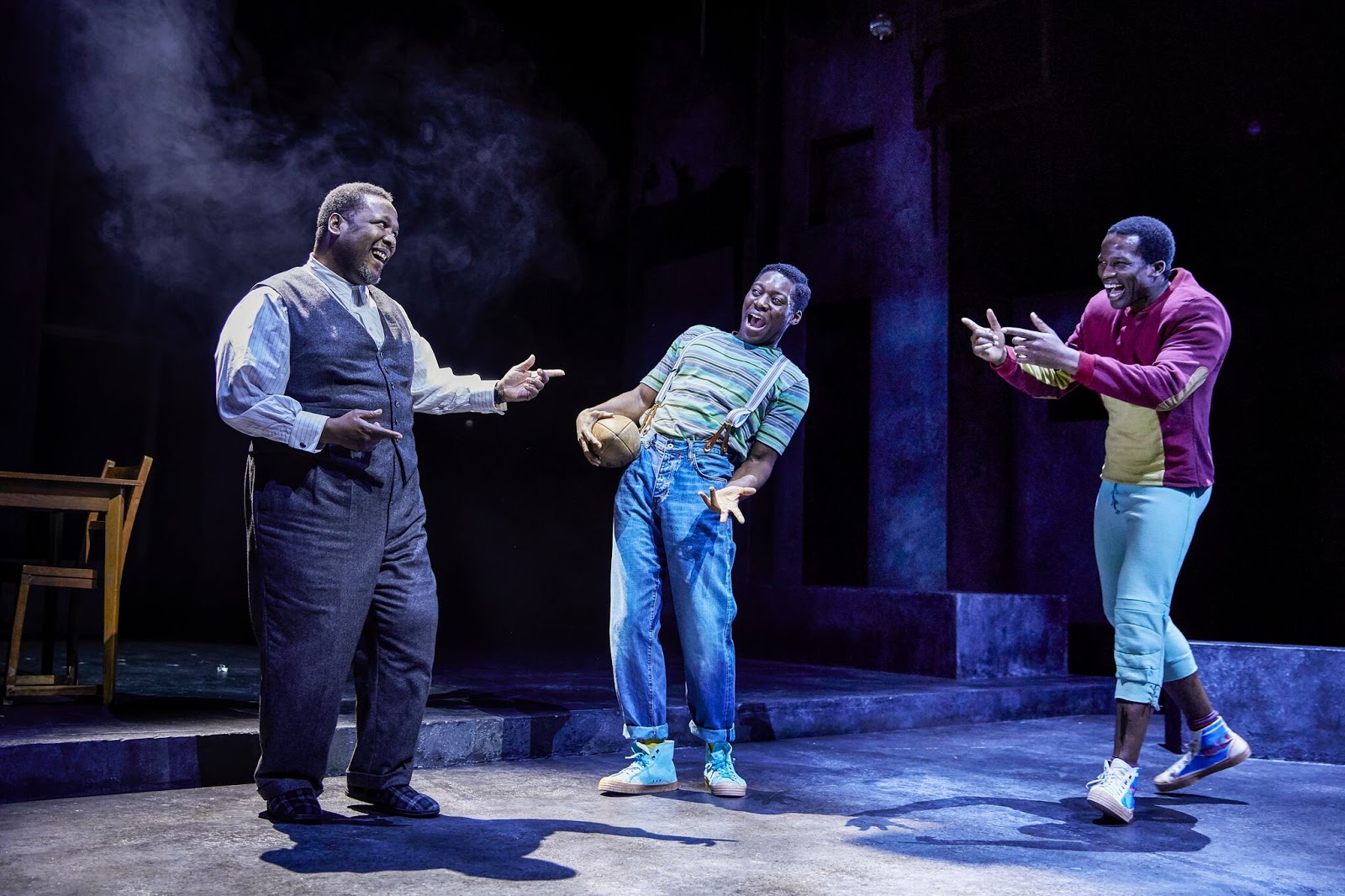
Pierce's Willie Loman with his sons, Sopé Dìrísù’s Biff and Natey Jones' Happy Loman. Credit: Brinkhoff/Mögenburg
The boys of the Loman family are strong in their turns as well, with Sopé Dìrísù’s Biff commanding a great presence and energy of his own alongside Natey Jones’ compelling Happy. In them both, resonant – indeed, renascent - themes of black struggle, and the attendant political contest of the means of liberation, persist. If their father is a Booker T. Washington type, intent on servile negotiation with the system, Happy is W E B Du Bois, determined to brook no restrictions on black freedom or enterprise, with the ambitious, soulful Biff instead a latter-day Marcus Garvey, insistent upon a need to get away from the capitalistic cruelties of city life to seek independent success away from New York’s hotbed of white prejudice, and from a system that demands he succeed only on its own terms. Jones and Dìrísù both perform with a keen awareness of this intertextual historical significance, and infuse their respective characters’ noble ambitions with a resultant richness, urgency, and complexity which it is a pleasure to watch, both actors transitioning skilfully from embodying their father’s fond hopes and dreams for them, to the pains and frustrations of their imperfect real lives.
Through Charlotte Sutton’s superb casting sensibilities, the Loman men’s struggles for success are ingeniously further situated as a struggle – both to beget and to be liberated from – proximity to whiteness. Whether by Willie leveraging the dorky white Bernard’s (a meek, earnest Ian Bonar) greater access to education for his underachieving son Biff, a literalised, torrid affair with whiteness embodied in Victoria Hamilton-Barritt’s seductive Woman, Joseph Mydell’s memorably enigmatic, gregarious Uncle Ben - dressed head-to-toe in conspicuously white finery whilst promising Willie diamonds for ever more toil - or the insensitive evil wrought by Matthew Seadon-Young’s cruel white boss Howard, the supporting cast is full of standout performances, enriching the drama and providing the play’s final revelation – that this essential release from capitalism’s myriad racialized cruelties comes, tragically, to mean very different things for Willie and his family - almost unbearably powerful, shocking dramatic effect.
Particular praise must go to set designer Anna Fleischle, whose singular, beautifully complex work has created something which seems as fluid and alive as any other character on her stage. It glides gracefully from scene to scene without interruption, with Aideen Malone’s dynamic lighting moving and changing just as seamlessly, much of it poignantly evocative of grim cold, and of a desolation both spiritual and material which is implicitly shot through the play’s text, made explicit by this wonderful design. Fleischle’s efforts seek to embody Willie’s erratic, panicked thoughts as he struggles with his patriarchal duty to his family, and his experience in a world which renders him small and insignificant against its own uncaring vastness. Fleischle’s spectacular achievement does just this, whilst also seeming to capture as well the transient, unstable nature of black life itself under such deplorable economic and social conditions. Hers is a truly masterful achievement, deserving of the highest commendation.
Left: Ian Bonar's Bernard with the Loman family. Credit: Brinkhoff/Mögenburg
Further manifesting the compellingly rich world of the play is the superb soundtrack, which pays loving tributes to both the bluesy jazz of the 20s’ Harlem renaissance and to the beautiful, soulful singing of the black gospel tradition, with tense and foreboding original composition underscoring Willie’s tragic tale in-between. Some fine costume work helps last of all, though not least, to put the final touches to a singularly brilliant production, which is never without tight direction from Elliot and Cromwell and consistently high energy from the spectacular cast. Although some transitions, particularly between penultimate scenes, seem somewhat out of step with the fluid grace of others, and energy may perhaps falter in places for having so often been taken to such extremes elsewhere, these are no detriment overall.
This incarnation of Miller’s most famous work is a superlative tour-de-force in every respect, a definitive theatre experience which is more than worthy of the standing ovation it received, and that deserves to be seen again and again.
Anna Fleischle has designed a beautiful set. Credit: Brinkhoff/Mögenburg
Also published in London Theatre Reviews, November 6th 2019: http://www.londontheatrereviews.co.uk/post.cfm?p=1954
Newly transferred from its lauded Spring season run at the Young Vic, directors Marianne Elliot and Miranda Cromwell bring their seminal production of Arthur Miller’s classic Death of a Salesman to the Piccadilly Theatre for Autumn.
Any production of Miller’s tragic, dramatic tale of the downtrodden Willie Loman and his desperate, seemingly hopeless struggles to make a living for his poor family passionately condemns the condescending nonsense of The American Dream, and the cruelty and abuse wrought by the excesses of capitalism on ordinary people – but this extraordinary reinvention confirms the long-held suspicions of many that Willie’s is a uniquely black socio-economic struggle by casting the Lomans as a black family from the South, eking out subsistence in the hurly-burly of 1930s’ New York, in the aftermath of both the Great Depression and the 1920s’ black cultural revolution throughout the American North.
Wendell Pierce and Sharon D. Clarke as the endearing Willie and Lorna Loman. Credit: Brinkhoff/Mögenburg
Elliot and Cromwell’s production is immediately enhanced with thematic urgency and with the depth of black history, one shared with a rich literary tradition of novels and plays, and which now seems so acutely necessary to any true grasp of this play that any other, white, staging of Willie Loman’s struggles comes off as almost wilfully ignorant and sorely lacking by comparison. Every aspect of Arthur Miller’s text is powerfully reinvented and reinvigorated, remade into a stirring clarion call against not only economic injustice, but all forms of racial discrimination under capitalism, and is rendered spectacularly better for it.
Leading a stellar cast with an outstanding performance is Wendell Pierce as Willie Loman. His new incarnation of Miller’s tragic hero masterfully embodies a unique shared history of distinctly black economic and social relations, brilliantly capturing a wonderfully complex interplay of forces bearing down upon him from within and without, his dogged adherence to the romantic notion of the American Dream always battling against a simultaneous harsh reality which he is endlessly driven to deny. Immediately commanding a powerful stage presence, Pierce’s Loman is by turns hugely energetic, funny, deeply complex and conflicted, and full of a palpable grief, frustration and anger ever-simmering beneath his seemingly happy exterior.
Sharon D. Clarke as wife Linda Loman beautifully performs a much-needed voice of calm and reason to Willie’s exhausting, hyperactive ambition, skilfully concealing her own pain and sorrow to play the dutiful, supportive wife – a sorrow which, when it fully emerges in the play’s most affecting scenes, is superbly realised. Together, their warm and loving relationship in their time together on stage, in bad times and good, is a heart-warming joy to behold, and full of great chemistry between the two.
Pierce's Willie Loman with his sons, Sopé Dìrísù’s Biff and Natey Jones' Happy Loman. Credit: Brinkhoff/Mögenburg
The boys of the Loman family are strong in their turns as well, with Sopé Dìrísù’s Biff commanding a great presence and energy of his own alongside Natey Jones’ compelling Happy. In them both, resonant – indeed, renascent - themes of black struggle, and the attendant political contest of the means of liberation, persist. If their father is a Booker T. Washington type, intent on servile negotiation with the system, Happy is W E B Du Bois, determined to brook no restrictions on black freedom or enterprise, with the ambitious, soulful Biff instead a latter-day Marcus Garvey, insistent upon a need to get away from the capitalistic cruelties of city life to seek independent success away from New York’s hotbed of white prejudice, and from a system that demands he succeed only on its own terms. Jones and Dìrísù both perform with a keen awareness of this intertextual historical significance, and infuse their respective characters’ noble ambitions with a resultant richness, urgency, and complexity which it is a pleasure to watch, both actors transitioning skilfully from embodying their father’s fond hopes and dreams for them, to the pains and frustrations of their imperfect real lives.
Through Charlotte Sutton’s superb casting sensibilities, the Loman men’s struggles for success are ingeniously further situated as a struggle – both to beget and to be liberated from – proximity to whiteness. Whether by Willie leveraging the dorky white Bernard’s (a meek, earnest Ian Bonar) greater access to education for his underachieving son Biff, a literalised, torrid affair with whiteness embodied in Victoria Hamilton-Barritt’s seductive Woman, Joseph Mydell’s memorably enigmatic, gregarious Uncle Ben - dressed head-to-toe in conspicuously white finery whilst promising Willie diamonds for ever more toil - or the insensitive evil wrought by Matthew Seadon-Young’s cruel white boss Howard, the supporting cast is full of standout performances, enriching the drama and providing the play’s final revelation – that this essential release from capitalism’s myriad racialized cruelties comes, tragically, to mean very different things for Willie and his family - almost unbearably powerful, shocking dramatic effect.
Particular praise must go to set designer Anna Fleischle, whose singular, beautifully complex work has created something which seems as fluid and alive as any other character on her stage. It glides gracefully from scene to scene without interruption, with Aideen Malone’s dynamic lighting moving and changing just as seamlessly, much of it poignantly evocative of grim cold, and of a desolation both spiritual and material which is implicitly shot through the play’s text, made explicit by this wonderful design. Fleischle’s efforts seek to embody Willie’s erratic, panicked thoughts as he struggles with his patriarchal duty to his family, and his experience in a world which renders him small and insignificant against its own uncaring vastness. Fleischle’s spectacular achievement does just this, whilst also seeming to capture as well the transient, unstable nature of black life itself under such deplorable economic and social conditions. Hers is a truly masterful achievement, deserving of the highest commendation.
Left: Ian Bonar's Bernard with the Loman family. Credit: Brinkhoff/Mögenburg
Further manifesting the compellingly rich world of the play is the superb soundtrack, which pays loving tributes to both the bluesy jazz of the 20s’ Harlem renaissance and to the beautiful, soulful singing of the black gospel tradition, with tense and foreboding original composition underscoring Willie’s tragic tale in-between. Some fine costume work helps last of all, though not least, to put the final touches to a singularly brilliant production, which is never without tight direction from Elliot and Cromwell and consistently high energy from the spectacular cast. Although some transitions, particularly between penultimate scenes, seem somewhat out of step with the fluid grace of others, and energy may perhaps falter in places for having so often been taken to such extremes elsewhere, these are no detriment overall.
This incarnation of Miller’s most famous work is a superlative tour-de-force in every respect, a definitive theatre experience which is more than worthy of the standing ovation it received, and that deserves to be seen again and again.
Anna Fleischle has designed a beautiful set. Credit: Brinkhoff/Mögenburg
Thursday, October 10, 2019
"Follow My Fingers" by Hannah West
Performed at The Bread and Roses Theatre, Clapham, October 9th 2019
Also published in London Theatre Reviews, October 10th 2019: http://www.londontheatrereviews.co.uk/post.cfm?p=1797
The first stage offering from new theatre and film company Rebel Act Productions, Follow My Fingers presents a strikingly dark, introspective tale of deep trauma and painstaking recovery for one young woman and her group of travelling friends.
Writer, director, producer, set designer, and lead actor Hannah West turns in a fine performance as Heather, skilfully alternating between pre and post-traumatic incarnations, one happy, bubbly, upbeat, and confident, and the other robbed of all enthusiasm for living as the work progresses, with Hannah West’s own minimalist set design fluidly intercutting from Heather’s variety of recollections to her time in therapy.
Many strong performances also litter the ensemble cast West has assembled for the work, nearly all female save one, and remarkable for the refreshing variety and depth of women’s personalities on display. Abigail Davies is a memorably mousy Sally, a pious woman of God, Hanna Durham’s Claire is a wellspring of humour with fine comic timing, Sophie Hill’s Annie provides a loud and boisterous counterweight to Sally, and Jessikah Wilson has an excellent manner with her client as Heather’s therapist, alongside smaller roles.
The work boasts a practically all-female cast of diverse characters
Meanwhile, Jamie Basardi’s solitary male presence displays great range as he convincingly performs a variety of different characters in vital bit-parts. Ably assisted by movement director Marlie Haco, the women in particular are all wonderful actresses, possessing great skill in transporting the audience from the confines of West’s sparse set surroundings into a variety of convincing scenarios and locations without the aid of extravagant sets or props, instead using movement and performance to create a variety of visually striking tableaus.
West’s writing is first-rate, too, with her script mounting in palpable tension and dread before finally exploding into an emotionally harrowing crescendo of traumatic shock and grief which makes a real, visceral impact.
Her script is full of energy, warmth, humanity, and humour, and explores everything from the prior build-up to the traumatic event itself, the aftermath, and the long, slow road to recovery. In all this, she shows great emotional sensitivity and a pleasing depth to her research of a charged and delicate central subject – her title, Follow My Fingers, is itself derived from the trauma therapy technique of replicating the rapid eye movement of dreaming to process shock in Eye Movement Desensitization Therapy.
Indeed, some of the more dramatic moments seemed so authentic and powerful that audience members were moved to tears. Though, perhaps, West’s talent for writing striking moments is a touch too great, as the play could’ve ended at several prior points in the last few minutes with no loss of quality; and, initially, as the play warms up to its impactful moments, the lighter writing seems to be very conventional youth travel story fare – but the larger dramatic moments at which West excels, and her talented cast, help to elevate the work beyond the usual standard, and its sincere, nuanced exploration of trauma by way of a conventional travel story is a refreshing twist which gives these proceedings an impressive narrative depth and broader socio-political importance in our age of sincerity and openness about mental health.
Jamie Basardi with Hannah West and Sophie Hill
Of great help to the depth of immersion in the tale is Zoe Smith’s sound and lighting together with Hannah West’s set design. The performance space makes an immediate impact, with its sparse and minimal white furniture visually striking against a sheer black background, which together with the cast unabashedly using the seating gangway as staging unto itself in a very enclosed space evokes the themes of intimacy and exposure very well. So, too, is there music on offer from the brother-sister duo of Sam and Hannah West, which joins the other elements of sound design in both adding to the initial lightness of tone and furthering a sense of later trauma, as Smith’s sound design gradually melds it into a disjointed cacophony of noise as Heather’s mind itself becomes a more confused and shaken environment.
A very well put-together, dramatic, and emotionally impactful work full of strong writing, wonderful design and great performances. As a very first theatre outing for a newly-formed company, Follow My Fingers is certainly an excellent, impressive initial effort. One looks forward to seeing where Rebel Act Productions, and the multi-talented Hannah West, go from here.
Also published in London Theatre Reviews, October 10th 2019: http://www.londontheatrereviews.co.uk/post.cfm?p=1797
The first stage offering from new theatre and film company Rebel Act Productions, Follow My Fingers presents a strikingly dark, introspective tale of deep trauma and painstaking recovery for one young woman and her group of travelling friends.
Writer, director, producer, set designer, and lead actor Hannah West turns in a fine performance as Heather, skilfully alternating between pre and post-traumatic incarnations, one happy, bubbly, upbeat, and confident, and the other robbed of all enthusiasm for living as the work progresses, with Hannah West’s own minimalist set design fluidly intercutting from Heather’s variety of recollections to her time in therapy.
Many strong performances also litter the ensemble cast West has assembled for the work, nearly all female save one, and remarkable for the refreshing variety and depth of women’s personalities on display. Abigail Davies is a memorably mousy Sally, a pious woman of God, Hanna Durham’s Claire is a wellspring of humour with fine comic timing, Sophie Hill’s Annie provides a loud and boisterous counterweight to Sally, and Jessikah Wilson has an excellent manner with her client as Heather’s therapist, alongside smaller roles.
The work boasts a practically all-female cast of diverse characters
Meanwhile, Jamie Basardi’s solitary male presence displays great range as he convincingly performs a variety of different characters in vital bit-parts. Ably assisted by movement director Marlie Haco, the women in particular are all wonderful actresses, possessing great skill in transporting the audience from the confines of West’s sparse set surroundings into a variety of convincing scenarios and locations without the aid of extravagant sets or props, instead using movement and performance to create a variety of visually striking tableaus.
West’s writing is first-rate, too, with her script mounting in palpable tension and dread before finally exploding into an emotionally harrowing crescendo of traumatic shock and grief which makes a real, visceral impact.
Her script is full of energy, warmth, humanity, and humour, and explores everything from the prior build-up to the traumatic event itself, the aftermath, and the long, slow road to recovery. In all this, she shows great emotional sensitivity and a pleasing depth to her research of a charged and delicate central subject – her title, Follow My Fingers, is itself derived from the trauma therapy technique of replicating the rapid eye movement of dreaming to process shock in Eye Movement Desensitization Therapy.
Indeed, some of the more dramatic moments seemed so authentic and powerful that audience members were moved to tears. Though, perhaps, West’s talent for writing striking moments is a touch too great, as the play could’ve ended at several prior points in the last few minutes with no loss of quality; and, initially, as the play warms up to its impactful moments, the lighter writing seems to be very conventional youth travel story fare – but the larger dramatic moments at which West excels, and her talented cast, help to elevate the work beyond the usual standard, and its sincere, nuanced exploration of trauma by way of a conventional travel story is a refreshing twist which gives these proceedings an impressive narrative depth and broader socio-political importance in our age of sincerity and openness about mental health.
Jamie Basardi with Hannah West and Sophie Hill
Of great help to the depth of immersion in the tale is Zoe Smith’s sound and lighting together with Hannah West’s set design. The performance space makes an immediate impact, with its sparse and minimal white furniture visually striking against a sheer black background, which together with the cast unabashedly using the seating gangway as staging unto itself in a very enclosed space evokes the themes of intimacy and exposure very well. So, too, is there music on offer from the brother-sister duo of Sam and Hannah West, which joins the other elements of sound design in both adding to the initial lightness of tone and furthering a sense of later trauma, as Smith’s sound design gradually melds it into a disjointed cacophony of noise as Heather’s mind itself becomes a more confused and shaken environment.
A very well put-together, dramatic, and emotionally impactful work full of strong writing, wonderful design and great performances. As a very first theatre outing for a newly-formed company, Follow My Fingers is certainly an excellent, impressive initial effort. One looks forward to seeing where Rebel Act Productions, and the multi-talented Hannah West, go from here.
Sunday, August 4, 2019
"Clara" by Elena Mazzon
Performed at Ram Jam Records at The Grey Horse, August 2nd 2019
Also published in London Theatre Reviews, August 4th 2019: http://www.londontheatrereviews.co.uk/post.cfm?p=1582
The history of classical music – as with many other fields of human endeavour – sadly too often omits the presence of great women from its cultural and historical memory. Fortunately, writer and performer Elena Mazzon together with director Catriona Kerridge issues a bold challenge to this unjust patriarchal dominion with Clara – Sex, Love and Classical Music, a one-women show devoted to vividly bringing Clara Schumann, née Wieck, the brilliant classical composer, pianist, and later wife to the better-known Robert Schumann, back to life in full colour to tell her story to the world.
Mazzon is superb as Clara, single-handedly carrying the entire show and creating a relentlessly energetic presence so vividly realised that one almost feels as though the former Wieck herself has emerged into the present day. Her performance – ably assisted by Peter Wernock’s voice and movement coaching - is a richly coloured tapestry of shared humanity in everything from her fiery, righteously feminist speech to the subtleties of her bold and confident body language. Mazzon’s beautifully written, evocative monologue charts a course through every aspect of Clara’s storied life from her remarkable childhood through to struggling to be an artistically ambitious, unreservedly sexual woman in 1830s Europe, to the tragic end of her marriage to Robert and beyond.
The skilful performance and writing together, broken up by apropos samples of Clara’s work performed live on the piano by Mazzon to lend proceedings a musica a programma significance thanks to musical director Stefania Passamonte, broadens and deepens our perception of Clara’s lived history, and gradually reveals more and more of a story of human triumph which is by turns dramatic, funny, heart-warming, and tragic in all the ways a life is. As a one-hander performance, Mazzon’s work is a joy to behold; as a first-time debut writer, she proves herself hugely talented and accomplished.
The candlelit interior of Ram Jam Records’ piano bar also proves a beautiful, intimate surrounding, keeping us in close proximity to Clara’s presence throughout, and maintaining the all-too appropriate sense amongst the audience of attending a concert or recital, which, in this instance, with the candlelight seemingly our only light source, creates a thrillingly mystic feeling of séance and resurrection to bolster the sense of the spirit of Clara being brought back to life.
Superbly realised, evocatively written, and beautifully performed drama altogether. A triumph.
Also published in London Theatre Reviews, August 4th 2019: http://www.londontheatrereviews.co.uk/post.cfm?p=1582
The history of classical music – as with many other fields of human endeavour – sadly too often omits the presence of great women from its cultural and historical memory. Fortunately, writer and performer Elena Mazzon together with director Catriona Kerridge issues a bold challenge to this unjust patriarchal dominion with Clara – Sex, Love and Classical Music, a one-women show devoted to vividly bringing Clara Schumann, née Wieck, the brilliant classical composer, pianist, and later wife to the better-known Robert Schumann, back to life in full colour to tell her story to the world.
Mazzon is superb as Clara, single-handedly carrying the entire show and creating a relentlessly energetic presence so vividly realised that one almost feels as though the former Wieck herself has emerged into the present day. Her performance – ably assisted by Peter Wernock’s voice and movement coaching - is a richly coloured tapestry of shared humanity in everything from her fiery, righteously feminist speech to the subtleties of her bold and confident body language. Mazzon’s beautifully written, evocative monologue charts a course through every aspect of Clara’s storied life from her remarkable childhood through to struggling to be an artistically ambitious, unreservedly sexual woman in 1830s Europe, to the tragic end of her marriage to Robert and beyond.
The skilful performance and writing together, broken up by apropos samples of Clara’s work performed live on the piano by Mazzon to lend proceedings a musica a programma significance thanks to musical director Stefania Passamonte, broadens and deepens our perception of Clara’s lived history, and gradually reveals more and more of a story of human triumph which is by turns dramatic, funny, heart-warming, and tragic in all the ways a life is. As a one-hander performance, Mazzon’s work is a joy to behold; as a first-time debut writer, she proves herself hugely talented and accomplished.
The candlelit interior of Ram Jam Records’ piano bar also proves a beautiful, intimate surrounding, keeping us in close proximity to Clara’s presence throughout, and maintaining the all-too appropriate sense amongst the audience of attending a concert or recital, which, in this instance, with the candlelight seemingly our only light source, creates a thrillingly mystic feeling of séance and resurrection to bolster the sense of the spirit of Clara being brought back to life.
Superbly realised, evocatively written, and beautifully performed drama altogether. A triumph.
Review: "Nostalgia" by Clive Moffatt
Performed at The White Bear Theatre, July 31st 2019
Also published by London Theatre Reviews, August 2nd 2019: http://www.londontheatrereviews.co.uk/post.cfm?p=1578
A new lyrical revue from Nomadic Theatrical Productions’ writer-director Clive Moffatt, “Nostalgia” is a narrative tour of various pasts told through the different recollections of a vibrant ensemble cast of characters, exploring the meaning, importance, and relevance of our memories of years gone by, especially in older age, and in the remembrances of young adults recalling their halcyon schooldays.
Clive Elliot, central to the cast as a flamboyant narrator, proves a highlight as a great storyteller, by turns funny, compelling, warm, and sincere with a strong, visually distinct stage presence. Liam Weller provides a nice contrast as a younger, knock-kneed schoolboy, bringing a charm and innocence to his rose-tinted recollections of school, and Jayne Beaumont as The Woman gives one of the most powerful and emotive performances, recalling a deeply troubled and traumatic past. Nick Rutherford and Ian Recordon meanwhile bring their own presence and emotive command of the text to the work nicely.
The writing itself, whilst having isolated moments of genuine, evocative affect and good craft, can sometimes feel disjointed, as though the series of monologues which bind the work together do not form a single coherent narrative so much as a series of writing exercises on a theme. Clive Moffatt’s light-touch direction together with Gwenan Bain and Chuma Emembolu’s lighting and sound, though, help to bring things together into a coherent whole, with Emembolu’s sound direction in particular making good use of some musical staples of classical and big band fare to evoke the titular nostalgia for a different era.
More an avant-garde exercise on a theme than anything particularly ground-breaking, certainly, but enjoyable performances and affecting writing help to bring everything together into a consistently interesting, reflective evening of theatre.
Clive Elliot with Ian Recordon as the Narrator and Older Man. Credit: Matthew Partridge
Also published by London Theatre Reviews, August 2nd 2019: http://www.londontheatrereviews.co.uk/post.cfm?p=1578
A new lyrical revue from Nomadic Theatrical Productions’ writer-director Clive Moffatt, “Nostalgia” is a narrative tour of various pasts told through the different recollections of a vibrant ensemble cast of characters, exploring the meaning, importance, and relevance of our memories of years gone by, especially in older age, and in the remembrances of young adults recalling their halcyon schooldays.
Clive Elliot, central to the cast as a flamboyant narrator, proves a highlight as a great storyteller, by turns funny, compelling, warm, and sincere with a strong, visually distinct stage presence. Liam Weller provides a nice contrast as a younger, knock-kneed schoolboy, bringing a charm and innocence to his rose-tinted recollections of school, and Jayne Beaumont as The Woman gives one of the most powerful and emotive performances, recalling a deeply troubled and traumatic past. Nick Rutherford and Ian Recordon meanwhile bring their own presence and emotive command of the text to the work nicely.
The writing itself, whilst having isolated moments of genuine, evocative affect and good craft, can sometimes feel disjointed, as though the series of monologues which bind the work together do not form a single coherent narrative so much as a series of writing exercises on a theme. Clive Moffatt’s light-touch direction together with Gwenan Bain and Chuma Emembolu’s lighting and sound, though, help to bring things together into a coherent whole, with Emembolu’s sound direction in particular making good use of some musical staples of classical and big band fare to evoke the titular nostalgia for a different era.
More an avant-garde exercise on a theme than anything particularly ground-breaking, certainly, but enjoyable performances and affecting writing help to bring everything together into a consistently interesting, reflective evening of theatre.
Clive Elliot with Ian Recordon as the Narrator and Older Man. Credit: Matthew Partridge
Subscribe to:
Posts (Atom)