Wednesday, July 10, 2019

Review: Henrik Ibsen’s An Enemy of The People by Jolley Goswald

Originally published in London Theatre Reviews, July 10th 2019 (http://www.londontheatrereviews.co.uk/post.cfm?p=1479)
Performed at the Playground Theatre.

Fringe company Here Now Ensemble, and their director Jolley Goswald, have certainly not shied away from the renewed social and political relevance of Henrik Ibsen’s original play. The dramatic tale of a principled, educated whistle-blower’s life being ruined by a corrupt, self-serving establishment that would rather profit from wilful ignorance of an imminent danger to the local community does indeed seem grimly topical in our modern, post-Brexit ,‘sick of experts’ political landscape, and the company’s very deliberate decision to perform in a venue literally down the road from Grenfell Tower places the writing within a chilling, morbidly timely new context.

It may have been enough, under these dire meta-fictional circumstances, simply to stage the original work and leave the audience to infer the modern meanings for themselves; but theatregoers expecting to arrive to a straightforward adaptation of Ibsen should leave their expectations in the foyer and prepare for an almost entirely new version of the play, one rewritten from the ground up to embrace modernity, and unafraid to explicitly name the problems of Brexit, austerity, capitalism and anti-feminism. Together with the production’s distinctly Brechtian fourth-wall-breaking sensibilities – its cast of characters named for their real-life actors, and lead Hannah van der Westhuysen explicitly halting the action to address the audience as participants, and state aims of using theatre as a forum for political engagement and calls to positive action - little remains here for fans of Ibsen but the bare-bones of his faithfully recreated plot, construed in an almost improvised, vulgar stream-of-consciousness by a talented and capable cast of performers with a strong stage presence. Purists may balk to find everything so changed, but it is a bold, fascinating approach to the text nonetheless.

Credit: Jolley Goswald

Goswald’s direction is full of laudable confidence in his vision and together with his actors he manages to never lose a refreshingly naturalistic, fast-paced feel and an engaging atmosphere which is always a pleasure, although it is not an approach that always works textually. At times, dialogue can feel a little too improvised, as though cast members are stumbling for where to go next, and perhaps, like Ibsen’s Thomas Stockmann, the writing’s great flaw is that it can sometimes be too upfront in its desire to tell its truths. One scene in particular, although very well performed by an energetic and impassioned Gabriel Akuwudike, veers perilously close to ludicrous soap opera melodrama that it can be difficult to take seriously, depending on one’s sensibilities. That said, at other times, when it works, there are genuinely great, pacey moments of compelling and affecting human drama that are well worth admission. It makes for something of a mixed bag, but one in which everybody is likely to find things they enjoy.

Meanwhile, Alys Whitehead’s compactly detailed set design visually helps along the writing’s ingenious transfer to distinctly modern, socialist millennial flat-share environs, Holly Ellis’ lighting lends dramatic thrust to all the right moments, and collaborating sibling Will Goswold’s sound design provides the enjoyable, youthful soundtrack. Doubtless many might find it an acquired taste, but it remains a brave, praiseworthy effort to revitalise the original text, full of talent, provocative originality, and life.

Friday, July 5, 2019

Review: Spitfire Sisters by Three of a Kind

(Originally published in London Theatre Reviews, July 5th 2019: http://www.londontheatrereviews.co.uk/post.cfm?p=1455)

Performed at The Space Theatre, July 3rd 2019

In 1973, the poet Harold Bloom famously wrote about what he called The Anxiety of Influence. The backbone of his theory of poetry, he thought that most new writers, inspired by reading about the greats that had come before, would feel too much pressure to measure up to them and to win their imagined approval. So they would buckle under the strain and end up producing derivative, ephemeral fare, of which the people they idolise would surely not approve.

Spitfire Sisters, the second offering from the writing team of Doc Andersen-Bloomfield, Catherine Comfort and Heather Dunmore, together known as Three of a Kind, is an ambitious work of new writing. Unfortunately, this fictionalised docudrama chronicling the history of the women serving in the Air Transport Auxiliary during World War II is let down by a host of peculiar, questionable creative decisions which keep the production – the earnest and laudable effort of giving women’s underappreciated history a sizeable platform and attempting to create something of which their forebears could be proud notwithstanding – from being all that it could be.
Things get off to a promising start with Sound Designer Kerri Chesser’s selection of classic Glenn Miller Big Band fare helpfully evoking the wartime spirit of the 40s, and the sparse set design suggesting the interior of the famous White Waltham Airbase, from which the women were deployed to deliver planes to the frontlines; but between lacklustre writing which the committed actors struggle to work with, Adam Hemming’s poltroonish direction and short-sighted staging, and Andy Straw’s confusing and irritating lighting design, things swiftly deteriorate into an unfocused, plodding bore which it is difficult to like, no matter how much one might want to.


Faye Maughan does her duty as Phyllis Griggs. Photography by Liz Isles

Above all, the distinctly one-dimensional writing, itself likely derivative of Giles Whittell’s non-fiction book Spitfire Women of World War II, pervades and tarnishes every other aspect of the production. The play’s cast of characters, all of which feel woefully underdeveloped and poorly written, especially in their oftentimes overformal and unrealistic dialogue, seem to be drawn from two historical figures each, leaving them feeling indistinct, and like poor substitutes for far more interesting individual historical figures. Faye Maughan’s Phyllis Griggs is clearly set in the mould of women like Rosemary Rees – whose husband urged her to purchase a personal Miles Hawk Major plane to improve her social life - and Pauline Gower – daughter of a high-up Tory MP, who fought for the right to wear trousers. Alessandra Perotto is the bold and brave Typhoon-flying, twice-Severn-Bridge-ducking Ann Wood and the spirited Jackie Cochran – who steadfastly refused to ever allow the British to “put her in her place” - at once, which unfortunately seems to cause her affected Appalachian American accent to constantly slip. Meanwhile, Mary Roubous endearingly combines the physically sickly intellect of Mary de Bunsen with the animal-loving introversion of the Argentine Picture Post pin-up Maureen Dunlop.

Unfortunately, this style of merging two distinct people and personalities together to create a single fictional analogue at best leaves the new characters feeling indistinct and underwritten, and at worst carries a meta-fictional suggestion that these women’s real lives and histories can be freely swapped around, tinkered with, and whittled down to useful storytelling props in the pursuit of crafting tiresomely didactic theatre. Their composite lives are unexamined and never fully realised, with the writing disinterested in saying anything more substantial about the significance of 40s-era women’s nobility, bravery, courage and sacrifice in wartime service to their country besides sternly finger-wagging at only the most glaringly obvious, almost cartoonish misogyny, and the self-evident economic injustice of a workplace earnings gap, lazily garnished with only the most superficial references to the real, unexamined history.

Indeed, for all the work’s promotional bluster about feminism, the writing is full of bizarre and ill-considered contradictions. In the course of the story – seemingly little more than a rudderless lecture on How Sexism Is Bad, which lacks any distinguishable narrative beginning, middle, or end - one so-called sister hands in her resignation early so she can run off to marry a rich man – naturally the most important priority in a woman’s life, never mind standing up to Hitler and the Nazis for her country. It is difficult to imagine that the late, great A.T.A pilot Joan Hughes, of the four-engine flight clearance elite, whom never married lest a man come between her and her love of flying, would approve of such antics.


The Spitfire Sisters face down an air raid in a dramatic moment. Photography by Liz Isles

Later on, a horrifically burned man (Steven Shawcroft’s RAF Airman Nigel in a totally unconvincing, obviously rubber face prosthesis) makes grossly inappropriate pleas to another woman not to risk flying because she’s too beautiful, lest a similar accident tarnish her pin-up model good looks (surely the only thing of value that she can contribute to the war effort) and then has his backwards attitude and thoroughly weird, stalky, out-of-nowhere infatuation – frightfully uncharacteristic of real A.T.A men that simply treated the women as respected colleagues - helpfully validated when she predictably dies in a crash. This despite many real female A.T.A pilots, like Amy Johnson, Audrey Sale-Barker and Joan Page, historically surviving numerous plane crashes and assorted in-flight emergencies, badly injured though they may have been. This way, he gets to feel justified in blaming the other women for her death, and claiming that it proves they don’t deserve to be paid properly for their work. Of course.

“Well, there we are, then.” one feels lead to think, “That’ll teach those uppity women not to do as they’re told by men who know better.” It’s all really rather troubling. This cast of characters seem at times to be a tragic far cry from their real-life inspirations; unlike Joan Hughes, who refused to marry and put paid to sceptical Air Force men, Jackie Sarsour who proclaimed flying “the most natural thing in the world…as though my entire life had led to this moment”, Mary de Bunsen taking to the skies explicitly to escape “the ghastly fate of the daughter-in-waiting”, Jackie Cochran’s life’s ambition to be known as “the greatest woman pilot in history”, Margaret Duhalde and Ann Wood both fearlessly giving male officers a piece of their mind, or Maureen Dunlop’s simple preference for animals over people, the fictionalised women’s excitement seems to peak most of all at the thought of getting to throw parties, wear pretty dresses, and talk about boys. It hardly seems fitting of the real legacy which supposedly inspired them to life.

Yet, instead of the rich storytelling potential of all of this history and legacy, we are left with the shallow, proscriptive writing pressing on the point of contemporary earnings gap concerns, with the stories of our war heroes seemingly being used as little more than an alluring backdrop to hang a portrait of misogyny which manifests in ways so unsophisticated and glaringly obvious that it feels risibly condescending, so much so that it does the far more subtle realities of misogyny itself a disservice in representation. Of course misogyny is real, and doubtless woven deeply into the fabric of our society and culture, sometimes into the very structure and form of language itself – far more deeply, surely, that a few tired, predictable, off-colour remarks of ‘but you’re only a woman!’ in so many drab variations. That much is – or certainly ought to be - obvious to anybody paying a modicum of attention. Indeed, in Russia, until World War II, one literally could not use terms like ‘infantry’ or ‘machine gunner’ or ‘tank driver’ without explicitly referring to a man. New words had to be invented from scratch just to create space for women in the army, because the very concept was unfathomable. Such is the deplorable breadth and depth of women’s oppression, whether in America, Britain, Russia, or anywhere else in the world we live in, be it in the 1940s, or the modern day.

That being said, the first rule of good writing is to avoid telling the audience things they already know.


Saluting noble efforts. Photography by Liz Isles

Matters are not helped by such a culturally, historically, and artistically informed work – uniquely by women, about women’s experience, and singularly for women - being left in the hands of a male director, which feels quite simply inappropriate in a great many respects. In practice, Hemming is forced into a grim Scylla and Charybdis scenario of either appearing to appropriate the work of women writers and to be bossing around a majority-female cast as he pleases, or else, all-too aware of these dreadful optics, being so overcautious and hands-off that he may as well have given up the task altogether. Either way, he is left doomed to such innate incompetence with the material that it really seems that the writing team has been recklessly inconsiderate in ever giving it to him in the first place. One can’t help but feel, with the production otherwise so intent on touting the importance of feminism and women’s representation, that a female director would surely have been more apt, and certainly far more competent at the task.

Hemming, though, seemingly opts for the latter directing style, and consequently, the play is left feeling too loose, disjointed, and lacking in firm directorial vision to make any positive impression. His cast struggle with a lack of direction or input on their characters, seeming only to read their lines as fast as possible, moments of drama fail to make any impact, and staging decisions are sometimes ridiculously impractical. More than once, actors are positioned so far to stage right that those sitting on the right-hand side in the back literally cannot see them. Meanwhile, Andy Straw’s irritatingly confusing lighting too often aims for ‘atmospheric low light’ and lands in ‘too dim to see anything from the back of the room’. Straw and Hemming are also far too fond of total blackouts, rankly abusing them for simple scene transitions to the point of the audience beginning to clap despite the play being far from over. It was of no help to the disjointed feel of the writing and the unconfident direction.

An earnest and experienced cast do their best despite it all, to be sure. Annabel Smith and Chloe Wade in particular do an admirable job of delivering characterful monologues which constitute some of the strongest writing in the otherwise weak text. Alas, to paraphrase Hitchcock: “To make a great play, you need three things – the script, the script, and the script.”


Chloe Wade and Mary Roubos as Jessie Harris and Georgia Smythe-West. Photography by Liz Isles

Spitfire Sisters is a disappointing, forgettable failure in nearly every aspect, crippled by the Anxiety of Influence – but Three of a Kind should not give up their worthy ambitions. Instead, they should and must try again. They must keep writing, keep improving, and keep on championing the cause of recording women’s erased history, and not only for themselves. At present, it is grimly true that women, especially those in the public eye – be they actors or writers – are not allowed to fail. Such is the ruthless, cruel, impossible perfection endlessly demanded of them. That this production has failed, given the weight of its own ambition and the daunting shadow of the legacy it exists in, is unsurprising and no-one should be too harshly blamed. Anyone would struggle in those circumstances.

More importantly, this failure is no bad thing. Women, like all people, must be allowed to fail and be given new chances to succeed, just the same as men. Only then we will have any sort of real equality.


Fly by night. Photography by Liz Isles.

Saturday, June 29, 2019

(Slightly) Long(er) Read: On "Fix Up" by Kwame Kwei-Armah

(A rather more...bloggy first draft of a review published in London Theatre Reviews, June 28th 2019: http://www.londontheatrereviews.co.uk/post.cfm?p=1439)

Performed at the Tower Theatre, June 27th 2019

Disclosure: I have been involved with the Tower Theatre since 2016 and am personally acquainted with some of the crew.

First performed in 2004 at the National Theatre in London, Kwame Kwei-Armah’s powerful drama of black identity, forgotten history, and divided loyalties has had a homecoming of sorts in being newly staged by the Tower Theatre in Stoke Newington. Reborn within Hackney borough, the beating heart of one of London’s most thriving minority communities, proceedings are immediately given a striking metafictional edge. Reborn within Hackney borough, the beating heart of one of London’s most thriving minority communities, proceedings are immediately given a striking metafictional edge, only strengthened by the significance of a restaging of such an unapologetically black play in 2019, in the throes of a new wave of sustained civil rights activism throughout the African diaspora. There is, after all, really no such thing as apolitical art.

Fix Up sees its protagonist Brother Kiyi (Richard Bobb-Semple, making his Tower Theatre debut) struggling to keep his titular bookshop, devoted to all manner of black biographical history, from closing down for want of customers. Even whilst his adopted son of sorts, the endearingly hapless Carl (Isiah Bobb-Semple), brings in boxes of new books, it seems that their community is more interested in chasing popular trends and fitting into a predominantly white society than in really connecting with their own uniquely black history and culture. Then, one day, Jasmine Rachelle’s Alice, a young mixed-race woman caught in the midst of both worlds and struggling to find her own meaningful identity, visits the shop, forcing a devastating reckoning with a dark and troubled past as personal as it is political.


Richard Bobb-Semple as Brother Kiyi. Credit: David Sprecher

Kwei-Armah’s writing has a wonderful strength and dramatic power, his dialogue crackling with the energy and eloquence of lyrical, rapid-fire patois, and given a sharp edge by (viewer be warned) unabashed deployment of the most explicit reclaimed racial term. His writing is brought to life by a hugely talented cast of actors, chief among them Rachelle and the elder Bobb-Semple. Both give moving, powerhouse performances, showing huge range and ability, and doing much to sell the play’s moments of genuinely emotionally devastating impact.

Isiah Bobb-Semple is a pleasure as the complicated Carl, the young man on a journey to articulate and come to terms with personal and political history, with Isiah moving deftly from the vivacious, youthful energy of his affected happy-go-lucky demeanour to the much more sombre notes of a grim past Carl still struggles with, and making it all believable as he goes. Meanwhile, Valerie Paul’s seemingly larger-than-life, no-nonsense Norma has an infectious energy and boldness about her, deftly commanding every scene she’s in, and Kieron Mieres skilfully rounds off the cast with an enjoyable, confident take on the hypocritical Kwesi, the shop’s wannabe Malcolm X in-residence, suspiciously more interested in capitalism than radicalism. All the cast pull off the work’s variety of complex, deeply flawed characters with aplomb and, in all the best moments of powerful human drama and tragedy, are wonderful to watch.

Supporting the cast is the stand-out work of the creative team, chief amongst them Holly Spice, whose ingenious set design frames the dilapidated Fix Up bookshop as a microcosmic distillation of the running theme of the foundation of black historical knowledge itself withering away and languishing in distinctly outmoded ‘uncool’ surroundings, whilst the faces of great black thinkers look on from their portraits in the background, their legacies of thought and action haunting the present of black life.


The spectre of black history haunts the present. Credit: David Sprecher

Phillip Ley’s sound design together with Sarah Assaf’s musical arrangement compliments this visual storytelling wonderfully, with a soundscape evocative of neglected black history that centres Marcus Garvey’s surviving words of righteous anger and indignation as they repeatedly puncture through the listless mundanity of the day-to-day, demanding an audience that will listen and take notice. Nick Insley’s lighting lends a beautifully solemn, portrait-like pathos to some moving, emotive monologues from the leads and heightens all the most shocking moments. Kwei-Armah’s lyrical patois, meanwhile, is brought out nicely by dialect coach Peta Barker.

Although events do build to a compelling, energetic and emotionally devastating finale in the second half, this leaves the first half, by comparison, seeming slowed down and slightly lacking in the same energy and momentum, with some of the longer pauses unfortunately suggesting delayed cues rather than dramatic effect, though this can easily be remedied in the coming performances. Nevertheless, director Landé Belo, in her Tower Theatre directorial debut, has accomplished quite a feat of storytelling, bringing a clear and confident vision to the text and creating work which is a richly thought-provoking and powerful pleasure to watch.


Isiah Bobb-Semple as Carl and Valerie Paul as Nora. Credit: David Sprecher

A final thought: doubtless, in our modern age, it seems that there will be some who are compelled to cynically label the work as a “black play”, and to superficially declare it as being about “black issues”, as though “blackness” is something to be relegated, resented and shunned, much like “women’s issues” is so often nastily deployed; but this amateurish view by a (likely) white commentariat contingent should be warned that they devalue work like Fix Up at everybody’s peril, including their own.

Of course, a term like “black issues” invites a problematic, reductive aspect; it is manifestly absurd to suggest a single, universal “black experience” or any one set of “black issues” (certainly, the play’s collection of characters are not an abstract monolith of rhetorical blackness, but complex, flawed human beings in conflict with one another) and there is a universality to the plea to remember and respect shared history and to find belonging and acceptance that will resonate with every viewer, irrespective of race - but this should surely not require downplaying or dismissing the blackness of the messengers, or the significance of their uniquely black experiences in shaping the message they deliver to us all: that our shared history is important, and worthy of attention, preservation and celebration of its moments of triumph. To merely dismiss it as a “black play” and its themes as “black issues” whilst our libraries and high street book shops close down by the day under austerity, and our centres of cultural and social history and knowledge vanish from our lives whilst we look away, distracted by trends on our social media feeds, is insanity.

Nevertheless, Belo’s work is a timely, accomplished reminder that perhaps, whether black or white, we should all put our phones away and make the time to stop by our local Fix Up.


Isiah Bobb-Temple as Carl and Jasmine Rachelle as Alice. Credit: David Sprecher

Review: Fix Up by Kwame Kwei-Armah

(Originally published in London Theatre Reviews, June 28th 2019: http://www.londontheatrereviews.co.uk/post.cfm?p=1439)

Performed at the Tower Theatre, June 27th 2019

Disclosure: I have been involved with the Tower Theatre since 2016 and am personally acquainted with some of the crew.

First performed in 2004 at the National Theatre in London, Kwame Kwei-Armah’s powerful drama of black identity, forgotten history, and divided loyalties has had a homecoming of sorts in being newly staged by the Tower Theatre in Stoke Newington. Reborn within Hackney borough, the beating heart of one of London’s most thriving minority communities, proceedings are immediately given a striking metafictional edge.

Fix Up sees its protagonist Brother Kiyi (Richard Bobb-Semple, making his Tower Theatre debut) struggling to keep his titular bookshop, devoted to all manner of black biographical history, from closing down for want of customers. Even whilst his adopted son of sorts, the endearingly hapless Carl (Isiah Bobb-Semple), brings in boxes of new books, it seems that their community is more interested in chasing popular trends and fitting into a predominantly white society than in really connecting with their own uniquely black history and culture. Then, one day, Jasmine Rachelle’s Alice, a young mixed-race woman caught in the midst of both worlds and struggling to find her own meaningful identity, visits the shop, forcing a devastating reckoning with a dark and troubled past as personal as it is political.


Richard Bobb-Semple as Brother Kiyi. Credit: David Sprecher

Kwei-Armah’s writing has a wonderful strength and dramatic power, his dialogue crackling with the energy and eloquence of lyrical, rapid-fire patois, and given a sharp edge by (viewer be warned) unabashed deployment of the most explicit reclaimed racial term. His writing is brought to life by a hugely talented cast of actors, chief among them Rachelle and the elder Bobb-Semple. Both give moving, powerhouse performances, showing huge range and ability, and doing much to sell the play’s moments of genuinely emotionally devastating impact.

Isiah Bobb-Semple is a pleasure as the complicated Carl, the young man on a journey to articulate and come to terms with personal and political history, with Isiah moving deftly from the vivacious, youthful energy of his affected happy-go-lucky demeanour to the much more sombre notes of a grim past Carl still struggles with, and making it all believable as he goes. Meanwhile, Valerie Paul’s seemingly larger-than-life, no-nonsense Norma has an infectious energy and boldness about her, deftly commanding every scene she’s in, and Kieron Mieres skilfully rounds off the cast with an enjoyable, confident take on the hypocritical Kwesi, the shop’s wannabe Malcolm X in-residence, suspiciously more interested in capitalism than radicalism. All the cast pull off the work’s variety of complex, deeply flawed characters with aplomb and, in all the best moments of powerful human drama and tragedy, are wonderful to watch.

Supporting the cast is the stand-out work of the creative team, chief amongst them Holly Spice, whose ingenious set design frames the dilapidated Fix Up bookshop as a microcosmic distillation of the running theme of the foundation of black historical knowledge itself withering away and languishing in distinctly outmoded ‘uncool’ surroundings, whilst the faces of great black thinkers look on from their portraits in the background, their legacies of thought and action haunting the present of black life.


The spectre of black history haunts the present. Credit: David Sprecher

Phillip Ley’s sound design together with Sarah Assaf’s musical arrangement compliments this visual storytelling wonderfully, with a soundscape evocative of neglected black history that centres Marcus Garvey’s surviving words of righteous anger and indignation as they repeatedly puncture through the listless mundanity of the day-to-day, demanding an audience that will listen and take notice. Nick Insley’s lighting lends a beautifully solemn, portrait-like pathos to some moving, emotive monologues from the leads and heightens all the most shocking moments. Kwei-Armah’s lyrical patois, meanwhile, is brought out nicely by dialect coach Peta Barker.

Although events do build to a compelling, energetic and emotionally devastating finale in the second half, this leaves the first half, by comparison, seeming slowed down and slightly lacking in the same energy and momentum, with some of the longer pauses unfortunately suggesting delayed cues rather than dramatic effect, though this can easily be remedied in the coming performances. Nevertheless, director Landé Belo, in her Tower Theatre directorial debut, has accomplished quite a feat of storytelling, bringing a clear and confident vision to the text and creating work which is a richly thought-provoking and powerful pleasure to watch.


Isiah Bobb-Semple as Carl and Valerie Paul as Nora. Credit: David Sprecher

Saturday, May 25, 2019

Review: The Merry Wives of Windsor by William Shakespeare

(Originally published in London Theatre Reviews, May 24th 2019: http://www.londontheatrereviews.co.uk/post.cfm?p=1287)

Performed at the Tower Theatre, May 23rd 2019

Disclosure: I have been involved with the Tower Theatre since 2016 and am personally acquainted with some of the cast and crew.

The latest in the Tower Theatre’s long tradition of touring Shakespeare productions to London and Paris for the summer, this time it falls to director Rob Ellis and his assistant Ciara Robley to deliver a new incarnation of Shakespeare’s comedy of righteous double-crossing and spirited, wifely rage.

With many of its central characters returning from Henry IV Part I and Henry IV Part 2, Wives’ comedy is oddly situated in Shakespeare’s body of work as a sort of side-story spin-off in which the grasping (in more ways than one, rather) buffoon Sir John Falstaff, enamoured with the sizeable dowries of the Windsor town wives, concocts a daft scheme to woo their assets out from under them. Naturally, the canny wives are having none of it, and so all the women of Windsor band together to show the dastardly old pervert what for.

Sangita Modgil and John Chapman as Master Ford and Sir Falstaff. Credit: Robert Piwko

The cast and crew make the best of what is often Shakespeare’s least well-regarded writing, wisely excising much of the dull, superfluous detail from the original script to make for a much pithier, faster-paced and more compelling production. Meanwhile, Max Batty and Lynda Twidale’s respective set and costume design transport proceedings to a lavishly-realised 1950s white picket fence incarnation of Windsor which is a gorgeously detailed pleasure to behold, and Colin Guthrie’s together with Ellis’ musical selections, full of contemporary rocking surf guitar numbers, lends everything a delightfully jaunty, carefree summertime atmosphere.

Playgoers in search of the thematic depth of Hamlet or vivid characterisations of The Scottish Play may be sorely disappointed by Wives, and perhaps find its comedic premise and characters far more simplistic and one-dimensional than the Bard’s more well-known fare, but Ellis’ cast does their level best with the material regardless. Amongst the highlights is John Chapman in a spirited starring role as a repulsive, lecherous – indeed, some may say grimly modern – Falstaff who is hugely entertaining to watch. Meanwhile, the Mistresses Ford and Page (Jill Davy and Helen McCormack) are both wonderfully energetic and compelling, with great camaraderie and chemistry between them, joined by Madeleine Gordon in an entertaining turn as the delightfully cunning Mistress Quickly. Sangita Modgil’s gender-bent Master Ford performs with great enthusiasm and vitality, carrying off her deliveries with a lively aplomb bordering on Time Lord, whilst James Van Langenberg makes for both an infectiously upbeat Nym and an endearingly sympathetic Master Fenton. There are surely some who will come for the Bard and stay for Daniel Watson’s gregarious, strongly-accented Sir Hugh Evans.

All the cast give earnest, committed performances, and all are ably assisted by Chris Mason and Anna Kovacs’ respective lighting and sound design, which creates compellingly atmospheric, absorbing, and evocative imagery to compliment what are at times vastly detailed, beautifully staged scenes of comic farce. That this is perhaps not Shakespeare’s best work is sometimes reflected in fluctuations in the energy of the production, but it remains a boldly upbeat, creative, and gorgeously put together evening of theatre, full of talent, and which never fails to entertain.

Garden party. Credit: Robert Piwko

Tuesday, May 21, 2019

Review: Boomerang by Ivana Mazza-Coates and Madeleine Shenai

Originally published in London Theatre Reviews, May 17th 2019 (http://www.londontheatrereviews.co.uk/post.cfm?p=1277)

Performed at the King's Head Theatre, May 18th 2019


It’s tough being young these days, and the dynamic writing-directing duo of Ivana Mazza-Coates and Madeleine Shenai are determined to prove it with their new work, Boomerang. So-called for the generation of unfortunate twentysomethings forced to turn around in the mid-flight of their fledgling lives and careers and beeline right back into an indefinite stay under their parents’ roofs, the result is a passionately realised and engaging evening of dramedy theatre firmly set in a noble Bernard Shavian tradition of socially conscious, didactic art, and a Bertolt Brecht-like insistence on the theatre as a forum for radical political ideas and discussion.

We follow Mauve (Megan Purvis) in her efforts to organise a dinner party with her old friend Holly (Alice Kerrigan). In the twilight of her twenties and still living with her mum, she struggles through working life desperately unfulfilled and already dreading an insignificant existence and oncoming elderly death. Meanwhile, her mother Mel (Nicola Wright) is beset with worry that her seemingly rudderless, idling daughter hasn’t grown up properly and begs her to do something meaningful with her life – circumstances surely too familiar to any millennial trying desperately to scrape together a respectable life in the midst of the economic desolation and social privations of austerity. Meanwhile, Holly has left things unsaid for years which threaten to implode her and Mauve’s friendship, and all this is before Mel’s recovering alcoholic, would-be new-age hippie boyfriend Len (Daniel Higley) has turned up to join them, in the throes of a pathetic mid-life crisis.

The play ruminates on all of the contemporary bugbears of “the Boomerang Generation”, amongst them a soul-crushing urge towards social presenteeism, the nagging, torturous sense that we’re too old to be where we still find ourselves in life, and all manner of spiritual desolation and existential pains, explored and examined in Mazza-Coates’ and Shenai’s bold, inventive, and quirky writing which is full of warmth, pithy humour and off-beat spirit. The strength and depth of their writing is a highlight, skilfully concealing a tangible darkness beneath the moments of humour and levity, suggesting a uniquely modern, suburban strain of Samuel Beckettian melancholy in a domestic landscape of shattered hopes and dreams, and evoking the tense, foreboding style of a Harold Pinter play in which everyone is at each other’s mercy and all pretence is doomed to crumble to dust, with a final Jim Cartwright-esque lightness of tone and keen sense of gallows humour just about managing to take the edge off of the undercurrent of oppressive misery.

The writing on show is ably assisted with strong performances from the entire cast. Nicola Wright is pleasingly cringe-inducing as Mel, making crass, embarrassing sex jokes and gauchely exposing her daughter’s private neurosis in front of her friend, every inch the pitiable forty-something still desperately wishing she was her daughter’s age, but one with a heart who genuinely cares for her child’s future. Daniel Higley’s Len is an energetic, entertaining highlight, making for a grimly funny, sad spectacle of decrepit middle-age clinging to wasted youth by his fingertips, brimful of vacuous, Instagram-ready new-age claptrap and painfully inadequate, pseudo-philosophical easy answers to deep-seated modern problems of the self.

Megan Purvis’ Mauve, meanwhile, is the millennial struggle incarnate. She masks spiritual desolation, dissatisfaction with her life, chronic loneliness, and her contentions with the myriad moral and ethical crises of her time with endearing warmth, peppiness, and clumsiness from her first moments on stage, creating a compelling and relatable character, and also proves herself capable of great range, delivering tender, observant monologues with great skill in a strong performance. Alice Kerrigan as Holly, meanwhile, immediately makes a fond impression, contrasting a lively, bubbly and sweet outward demeanour with a mousy and anxious bent which betrays suppressed depth of feeling. She shows a similarly great range, going from upbeat mousiness to shocking, erratic derangement, giving her role emotional intensity and impressively carrying off beautiful monologues on love.

Beyond the writing and performances, production designer Shanti Gordon’s picturesque, richly detailed set is a pretty sight to behold even before the show has begun, casting events against the background of a baby-blue sky and lending proceedings the feeling of a series of grimly contrasting, artful portraits of modern life, with her jaunty, youthful choice of background music setting a light, breezy tone against which to messily juxtapose and emphasise the heights of intense, beautifully performed human drama the work ascends to by its end.

All told, with its history of being first performed as scratch, and now as a stage play, Boomerang retains a distinctly experimental, nascent feeling throughout of being perhaps slightly underwritten and not yet as fully-formed as it could be with more development time; but even in its current form it nevertheless remains a beautifully staged, powerfully performed, thought-provoking, and compelling human drama capable of reaching great dramatic heights. Its run has ended, but in its wake it leaves behind an intriguing proof-of-concept and high hopes for what producer Paula McGann’s all-female company posse can achieve with their forthcoming television adaptation. I look forward to seeing it.

Sunday, May 19, 2019

Review: Hellblade: Senua’s Sacrifice (Ninja Theory, 2017) #WorldMentalHealthWeek


Ninja Theory’s Hellblade: Senua’s Sacrifice doesn’t lend itself to being described in terms of a typical game. On the contrary, one has to resist the urge in reviewing it to write hundreds of words about little more than the personal effect it has on its players, because it goes so far out of its way to avoid being anything like what we might think of as an ordinary modern gaming experience. In fact, it isn’t so much a game– and certainly not the high-octane hack-and-slash adventure that its initial public advertising pitch suggested - as it is an oftentimes relentlessly bleak, unnerving, and disturbing experience about serious mental illness, and what it means to go through Hell. In the course of the titular Celtic warrior Senua’s journey through the Viking underworld in search of her partner’s lost soul, so much is done to touch upon the uniquely personal causes of complex mental illness and the realities of living with it - isolation, ostracism, severe trauma, abuse, bereavement, abrupt and unpleasant ends to important relationships, none of which are usually the subjects of your typical video game plot - that a deeply personal, affecting experience emerges, which I’m loathe to go into too much revealing detail about for fear of spoiling it for others.

That being said, as a game, strictly speaking, Hellblade doesn’t feel any need to reinvent the wheel, and players won’t find anything spectacularly new in terms of its overall design or mechanics. Instead, in every aspect of its creative input, from art style and direction to sound, narrative, and level design, to gameplay mechanics, Hellblade is far more interested in being an interactive simulation of having a mental illness rather than being another action game. The experience is divided into puzzle solving and combat sections, the former consisting of searching for visions of Nordic runes to unlock the path forward, and dispelling illusions by finding the right vantage point to be able to see through them, in a clever meta-narrative representation of the experience of seeing things and patterns which aren’t actually there so common to the real-life sufferers of Senua’s psychosis.

Senua battles her demons. Credit: Ninja Theory

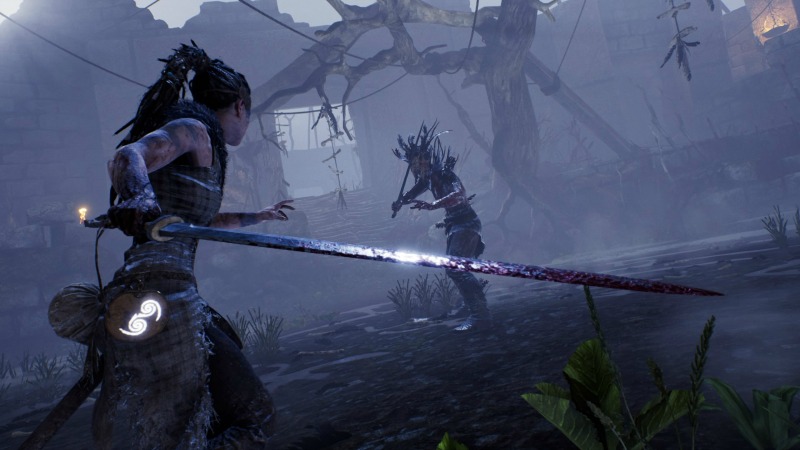
Meanwhile, fighting in Hellblade is a fairly accurate representation of actual mano-a-mano broadsword fighting – in other words, slow and heavy, encouraging careful manoeuvring in battles that can become extremely tense and stressful, numbering as many as 4 or 5 heavily armed and armoured foes against one (albeit one with several voices in her head helpfully spurring her on) in the later stages, as well as a few inventive boss battles along the way. So far as controlling all of this goes, there’s the standard division of combat into light, heavy, and melee attacks on a face button each, with blocking and timed parrying on the left bumper of a standard Xbox 360 PC controller, and although the controls are never anything less than responsive and satisfying to use, those seeking any mechanical depth and complexity or the stereotypical video game warrior power fantasy from Hellblade’s combat systems will be disappointed. Instead, Hellblade’s simulation de-emphasises confrontation, with combat sections few and far between in a thoughtful riposte to the wildly inaccurate, stereotypical association of mental illness with violence. Entire lengthy sequences see Senua totally unarmed and far more at risk of harm from others than likely to do harm to them, all whilst she nevertheless remains extremely ill, as is so often the case in reality.

At other times in the game, there’s little to occupy you except walking at a middling stride through the environment whilst a narrator recites Norse mythology to you, discovered by going off the beaten path to seek out the many hidden Lorestones in the levels, all whilst the voices continue to endlessly chatter and complain inside your head. This isn’t necessarily a negative either, with the game’s Unreal Engine 4 being put to great use in showing off vast, visually stunning mythic landscapes awash with gorgeous lighting and effects and full of attention to detail. Everything is beautifully, fluidly animated as well, with Senua’s movement consistently weighty and convincing, and combat animations are suitably forceful and impactful, making every armed encounter with the visually striking, nightmarish enemies intense, visceral, and satisfying.

The Unreal Engine's visuals draw surreal beauty out of the dark. Credit: Ninja Theory


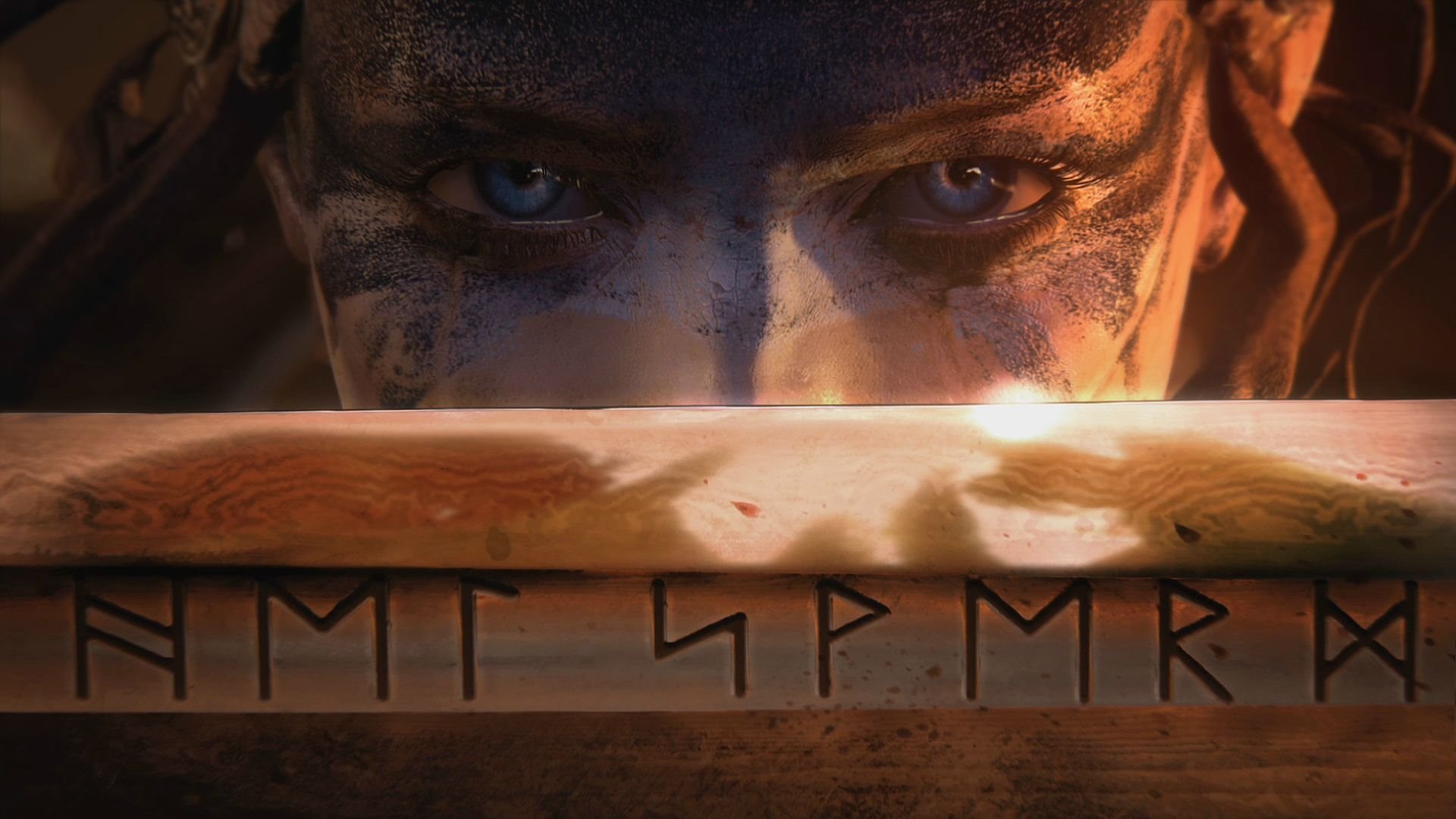
In its art direction and audio-visual design, Hellblade is consistently a strikingly beautiful, thought-provoking experience that from its opening moments manages to be disarmingly impactful and compelling, so much that I became utterly absorbed in the story and within moments forgot that I was playing a game, not thinking to simply press Pause and bring up the convenient list of the controls when Hellblade steadfastly refused to garishly take up screen space with anything as typically game-ish as tutorial messages or a UI. Instead, I found myself feeling my way through the unknown without help, ignorant of what to do exactly, and desperately trying to make sense of it all, in much the same way I imagined Senua must have to. Ingeniously, the recordings for the ceaseless voices she hears in her head have been captured with a binaural microphone, so players that go along with the recommendation to use proper headphones can fully experience an unnervingly accurate simulation of the auditory hallucinations central to Senua’s mental health crisis. Altogether, as a carefully crafted, simulated experience of mental illness, Hellblade is a peerless triumph, so much so that the game took home not just one, but five BAFTAs earlier this year, with Ninja-Theory’s in-house-video-editor-turned-lead-actress Melina Juergens deservedly winning Best Performer over some very stiff professional competition for her extraordinary motion capture and voice work as Senua. She gives a powerful, evocative, and affecting performance here which is more than worth a playthrough just to witness by itself.

Hellblade does, though, have its flaws as a game. The endless searches to find runes in the environment can become tedious, design attempts to lessen this frustration notwithstanding, enemy types are lacking in variety and, depending on how good your sense of direction is, navigating the more labyrinthine environments and puzzles themselves might tend to get perplexing and slightly frustrating for some players. More than once, I found myself looking up a guide to clear these roadblocks and carry on with Hellblade’s gripping story, which the shallow surrounding gameplay systems can sometimes seem to be little more than a distraction from. Frankly, Hellblade isn’t even a particularly fun or entertaining game much of the time. Instead, it’s frequently harrowing and full of deeply disturbing sound and imagery unsuited to the faint of heart. Hellblade makes it abundantly clear before players have even made it to the main menu, though, that it is not meant as trifling entertainment, that its subject matter is not to be taken lightly, and that to go in expecting a typical action game is to miss the point of Hellblade’s intention to be an interactive experience of psychosis more than anything else.

All the signs of madness. Credit: Ninja Theory

Players willing to steel themselves and keep an open mind, though, will find that Hellblade is an outstanding storyteller, dazzling with an array of creative narrative tricks and design techniques to convey Senua’s warped reality to us – including one particularly clever instance that wonderfully captures the experience of obsessive-compulsive catastrophizing through visual design and co-opting the player’s own broader acquired knowledge of typical game mechanics. The uniquely interactive nature of gaming itself becomes very enlightening on the difficult topic in that Senua’s insanity ultimately doesn’t matter. If we, the player, want to get anywhere in letting her story be told, or helping her overcome the challenge in front of her, and ourselves, we have to start by fundamentally accepting that her perception of the world is as real and valid as ours, internalise it, co-operate with her, listen to the voices inside her head, and be open to seeing things and patterns that, as far as she’s concerned, are there, even if we know that they aren’t really. The suspension of disbelief which you need to participate in fiction in and of itself serves the narrative, and builds empathy with the strange lived experiences of the seriously mentally ill. In doing all of this, what Hellblade can be said to be, if it is anything, is proof of what games as a medium are capable of doing with a narrative, and that makes it tremendously, groundbreakingly important.

It’s also hugely significant that of the five (count ‘em, five!) BAFTA awards Hellblade won, one was in the category of Game Beyond Entertainment. Whereas before the inherent flaw of literature, theatre, or film was that we had inbuilt hard limits on our potential proximity to other lives and experiences, we now have powerful technology in games that allows us to be placed almost directly into the bodies and minds of fictional people, to see their world as they see it, hear their thoughts inside our own heads, and to walk for hours or days in their shoes. For years, all of these other mediums have been given permission to be more than just entertainment, and Hellblade stands out as by far one of the most convincing cases that the industry has ever presented that it is time, in our day and age, to finally grant the medium of games the same leave. Its uncompromising portrayal of serious mental illness is more authentic, compassionate and respectful to those that actually live with it than most films, which have had more than a century to improve and refine themselves, and yet too often continue to cynically, abusively, and dangerously exploit their portrayals of mentally ill human beings, making them into little more than cheaper substitutes for B-movie monsters.

Melina Juergens gives an outstanding motion-capture performance as the warrior Senua. Credit: Ninja Theory

Developer and publisher Ninja Theory, meanwhile, working within a far younger and less experienced medium, have done an excellent job doing their homework on mental illness and psychosis, bringing in a wide range of expertise from psychiatry professors at Oxford to professionals working within mental health services, and – most crucially – ordinary people from all walks of life with lived experience of the condition. Consequently, there’s a raw, visceral quality to everything Senua goes through in her illness because no aspect of it has been made up, and her story has an unusual, affecting power in knowing that somewhere in the world is a real person that has experienced at least some part of what she does. It’s to the credit of all the staff on the game that the writing and handling of these representations has been treated with such care and consideration at every step of the creative process that exposure to it – as much as it often distresses and disconcerts – never inspires pity, only empathy and an increased understanding of what it is like to live with such a serious illness, and it is because of – not in spite of – the uniquely interactive element of gaming’s form and function that this effect is achieved. In being compelled to directly, personally interact with Senua and her experience of her illness, we can’t fully separate it from ourselves, or other her as being unlike us, as we could so easily with films, a stage play, or a book. Her experiences must, on some fundamental level, become our own if we want to meaningfully engage with the game. To create that kind of kinship with the experience of another recognisably human being should surely be the highest aspiration and greatest accomplishment of any form of art.

To that end, Hellblade is a superb demonstration that the potential of games for storytelling, education, and consciousness-raising is limitless in a way no other art form has had liberty to be in our history, and whilst it may not be a perfect game by any means, it deserves to be remembered as a sincere and accomplished effort to advance the intellectual and emotional breadth, depth, and capacity of the entire medium. Indeed, perhaps the best understanding of the experience of living with precarious mental health for newcomers to the topic can be gained simply by playing Hellblade again a second time. It’s not any less scary, but you can plan for what’s coming now. The voices don’t go away. They never go away, but you can learn to accept them being there, and to listen when they help, and shut them out when they don’t. Eventually, you can figure out how to cope, and to learn to live with the reality of it.

That means a lot.